Shows / The Joy of Why
The Joy of Why
“The Joy of Why” is a Quanta Magazine podcast about curiosity and the pursuit of knowledge. The mathematician and author Steven Strogatz and the cosmologist and author Janna Levin take turns interviewing leading researchers about the great scientific and mathematical questions of our time. New episodes are released every other Wednesday.
Quanta Magazine is a Pulitzer Prize–winning, editorially independent online publication launched and supported by the Simons Foundation to illuminate big ideas…
Episodes
 The Joy of Why
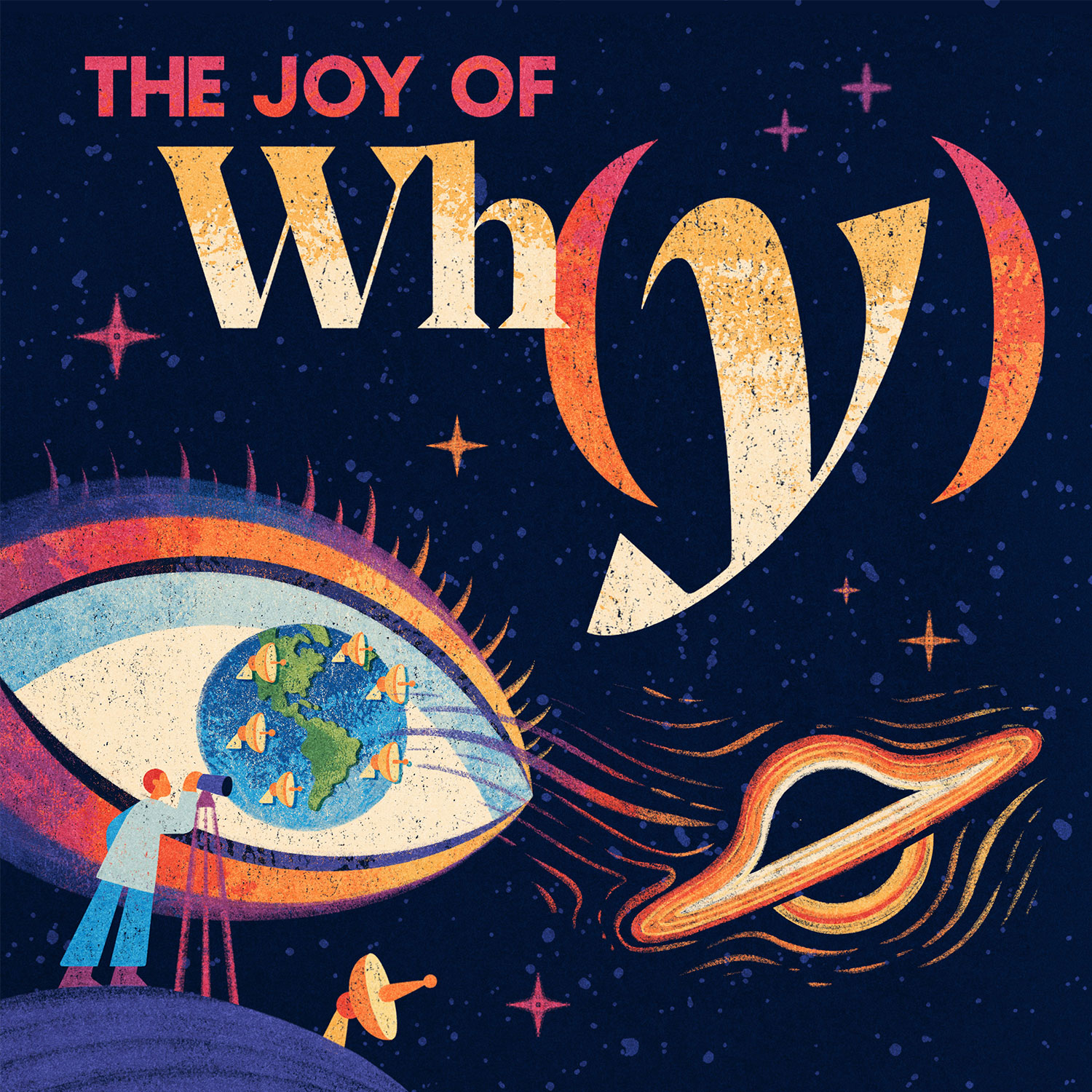
How Do You Take a Picture of a Black Hole?
Black holes are one of the universe’s most exotic and elusive objects. When nothing, not even light, can escape their powerful gravitational grasp, taking a…
 The Joy of Why
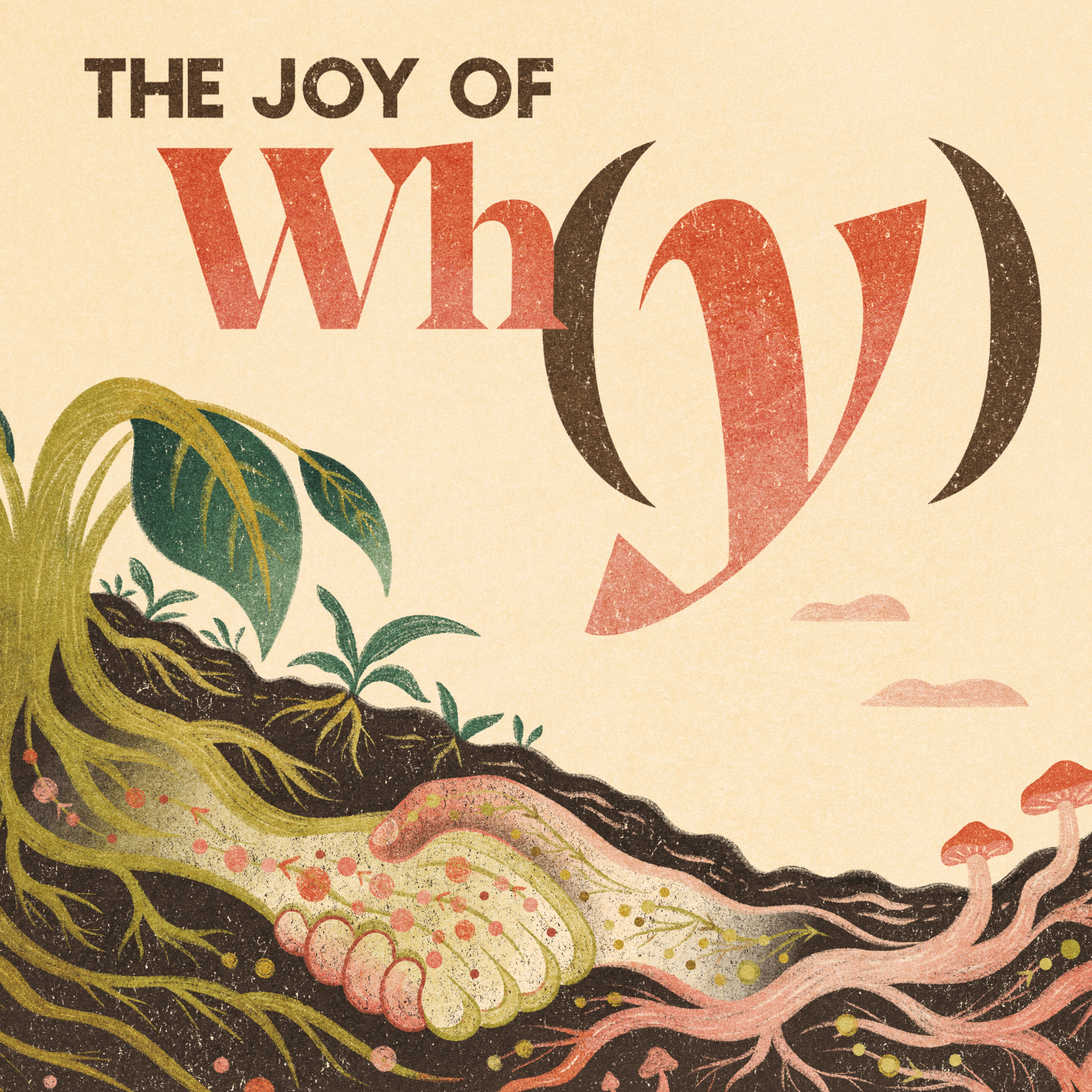
How Do Fungi Keep the Planet Healthy?
People may think of soil as just dirt, but it is anything but inert. Beneath your feet, a vast network of mycorrhizal fungi is hard at work, trading minerals…
 The Joy of Why
What Does the Fourth Dimension Actually Look Like?
We know all about how things exist in the three dimensions of length, width, and height. Physicists often talk about time as a fourth dimension, but what if…
 The Joy of Why
Where Does the Quantum World End and Ours Begin?
Quantum mechanics may be one of the most precisely tested paradigms in science, but there’s still no universally accepted interpretation of what it tells us…
 The Joy of Why
Live from ICM 2026: What Is Math For in the Age of AI?
Mathematicians are witnessing a profound shift in their field. AI systems are now producing proofs, spotting connections between distant fields, and, in a few…
 The Joy of Why
Are We Thinking Correctly about AI Intelligence?
When an LLM answers a question, is it reasoning like humans, or just producing text that looks like reasoning? The distinction isn’t just philosophical, this…
 The Joy of Why
How Does Touch Lead To Pain Or Pleasure?
Pain and pleasure seem like simple facts of life, but they are far from it. Neuroscientists still cannot say why physical pain differs from psychological pain…
 The Joy of Why
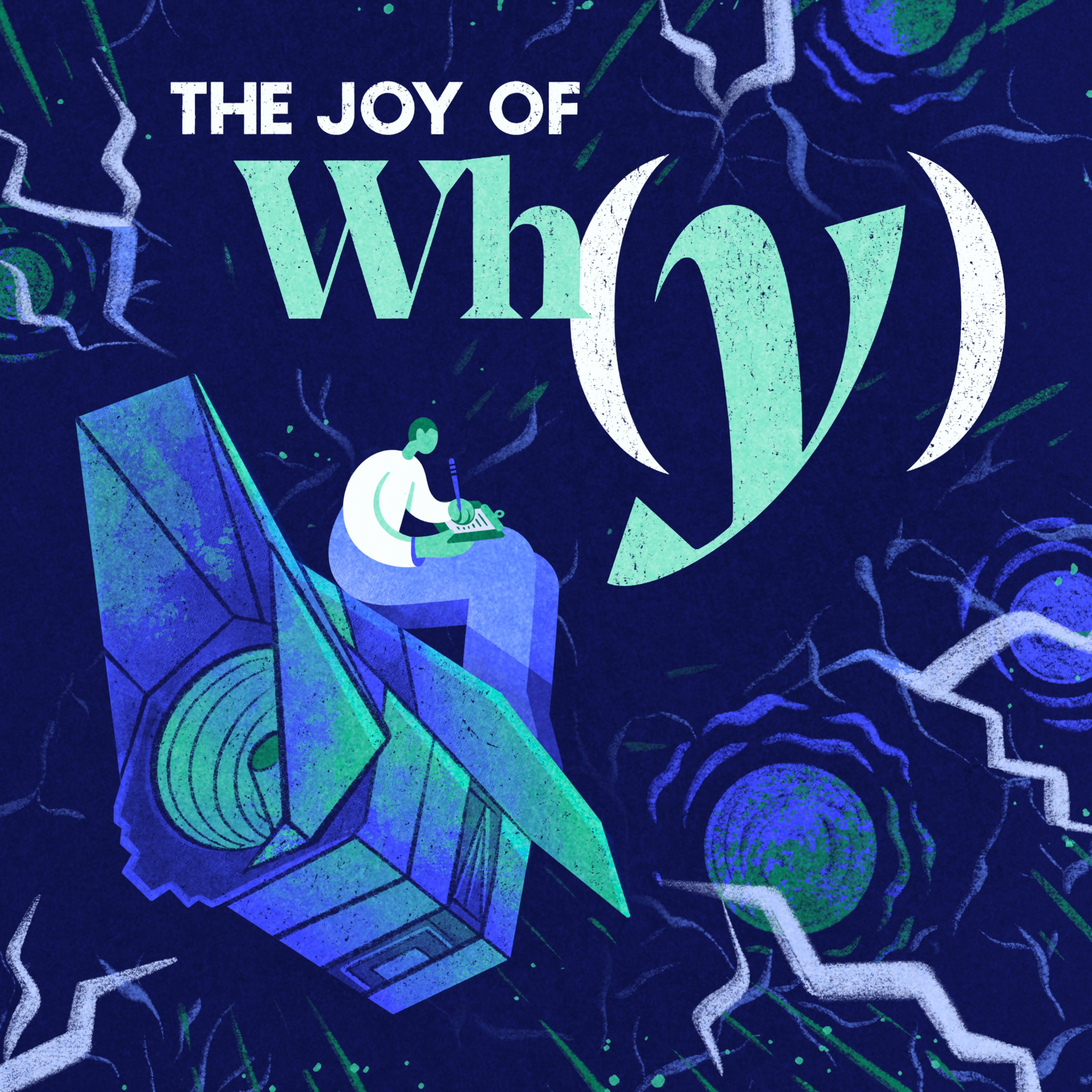
How Fast Is the Universe Really Expanding?
One of the biggest mysteries in cosmology seems to keep getting bigger. Astronomers have known since the 1930s that the universe is expanding, but in the…
 The Joy of Why
Will We Ever Find Alien Civilizations?
Does intelligent life exist elsewhere in the universe? The question has captivated us for centuries, but despite decades of searching it remains frustratingly…
 The Joy of Why
What Is the Positive Grassmannian and Why Does It Show Up Everywhere?
What links certain mathematical models of traffic flow, shallow-water waves, and quantum particle scattering? The surprising answer lies in a corner of the…
 The Joy of Why
What’s the Future of Gene Editing?
One of the most surprising and remarkable discoveries in recent scientific history has been CRISPR. Short for Clustered Regularly Interspaced Short Palindromic…
 The Joy of Why
More Conversations, Complex Questions, and Bold Ideas in Season Five of ‘The Joy of Why’
What is the future of gene editing with CRISPR? Has AI changed mathematics forever? Will we find other civilizations in the universe? What if we’ve been wrong…
 The Joy of Why
Do Beautiful Birds Have an Evolutionary Advantage?
Birds are not merely descendants of dinosaurs — they are dinosaurs. For Yale evolutionary biologist and ornithologist Richard Prum, birds have been a lifelong…
 The Joy of Why
How Can Math Protect Our Data?
Every time data travels — from smartphones to the cloud, or across the vacuum of space — it relies on a silent but vigilant guardian in the form of…
 The Joy of Why
Why Did The Universe Begin?
Most cosmologists agree that our universe had a beginning. But the finer details about the Big Bang remain a mystery. A history of everything would explain…
 The Joy of Why
How Can Regional Models Advance Climate Science?
Climate models have changed the way we view the world. While effective, these models are imperfect, and scientists are constantly looking at ways to improve…
 The Joy of Why
How Does Graph Theory Shape Our World?
Born in the 18th century when Leonhard Euler solved the puzzle of the seven bridges of Königsberg, graph theory has become a foundational tool in mathematics…
 The Joy of Why
Does Form Really Shape Function?
What links a Möbius strip, brain folds and termite mounds? The answer is Harvard University’s L. Mahadevan, whose career has been devoted to using mathematics…
 The Joy of Why
Will We Ever Prove String Theory?
For decades, string theory has been hailed as the leading candidate for the theory of everything in our universe. Yet despite its mathematical elegance, the…
 The Joy of Why
How Did Geometry Create Modern Physics?
Geometry is one of the oldest disciplines in human history, yet the worlds it can describe extend far beyond its original use. What began thousands of years…
 The Joy of Why
Will AI Ever Understand Language Like Humans?
Large language models (LLMs) are becoming increasingly more impressive at creating human-like text and answering questions, but whether they can understand the…
 The Joy of Why
Can Quantum Gravity Be Created in the Lab?
Quantum gravity is one of the biggest unresolved and challenging problems in physics, as it seeks to reconcile quantum mechanics, which governs the microscopic…
 The Joy of Why
What Is the True Promise of Quantum Computing?
Quantum computing promises unprecedented speed, but in practice, it’s proven remarkably difficult to find important questions that quantum machines can solve…
 The Joy of Why
How Did Multicellular Life Evolve?
At first, life on Earth was simple. Cells existed, functioned and reproduced as free-living individuals. But then, something remarkable happened. Some cells…
 The Joy of Why
S4 Preview: More Big Questions and No Sasquatches
How did complex life evolve? Where did space-time come from? Will computers ever understand language like we do? How did geometry create modern physics? These…
 The Joy of Why
How Will We Know We’re Not Alone?
We have identified thousands of planets just in our neighborhood in the Milky Way, mostly from the way they impact their host stars. Basic calculations suggest…
 The Joy of Why
How Is Cell Death Essential to Life?
Death might seem like a pure loss, the disappearance of what makes a living thing distinct from everything else on our planet. But zoom in closer, to the…
 The Joy of Why
What Can Birdsong Teach Us About Human Language?
It’s fair to say that enjoyment of a podcast would be severely limited without the human capacity to create and understand speech. That capacity has often been…
 The Joy of Why
How Is AI Changing the Science of Prediction?
Scientists routinely build quantitative models — of, say, the weather or an epidemic — and then use them to make predictions, which they can then test against…
 The Joy of Why
Why Is It So Hard to Define a Species?
The “species” category is almost certainly the best known of all the taxonomic classifications that biologists use to organize life’s vast diversity. It’s a…
 The Joy of Why
How Can Math Help Beat Cancer?
When we think about medicine’s war on cancer, treatments such as surgery, radiation and chemotherapy spring to mind first. Now there is another potential…
 The Joy of Why
What Can Cave Life Tell Us About Alien Ecosystems?
If instruments do someday detect evidence of life beyond Earth, whether it’s in this solar system or in the farther reaches of space, astrobiologists want to…
 The Joy of Why
From Sidedoor — Cosmic Journey I: "Stellar Buffoonery"
As a treat to our listeners, we are posting a full episode of Sidedoor, a podcast that explores the treasures in the Smithsonian's vaults. Subscribe to…
 The Joy of Why
Can Thermodynamics Go Quantum?
The principles of thermodynamics are cornerstones of our understanding of physics. But they were discovered in the era of steam-driven technology, long before…
 The Joy of Why
Do We Need a New Theory of Gravity?
Observations of the cosmos suggest that unseen sources of gravity — dark matter — tug at the stars in galaxies, while another mysterious force — dark energy —…
 The Joy of Why
Are Robots About to Level Up?
Within just a few years, artificial intelligence systems that sometimes seem to display almost human characteristics have gone from science fiction to apps on…
 The Joy of Why
How Does Math Keep Our Secrets?
Can you keep a secret? Modern techniques for maintaining the confidentiality of information are based on mathematical problems that are inherently too…
 The Joy of Why
Will AI Ever Have Common Sense?
Common sense rules our world. This fundamental, sometimes trivial knowledge is inherent to how humans interpret language. Yet, some of these simple human…
 The Joy of Why
What Can Tiling Patterns Teach Us?
In the tiling of wallpaper and bathroom floors, collective repeated patterns often emerge. Mathematicians have long tried to find a tiling shape that never…
 The Joy of Why
How Is Science Even Possible?
The universe seems like it should be unfathomably complex. How then is science able to crack fundamental questions about nature and life? Scientists and…
 The Joy of Why
Can Psychedelics Improve Mental Health?
During traumatic periods and their aftermath, our brains can fall into habitual ways of thinking that may be helpful in the short run but become maladaptive…
 The Joy of Why
What Happens in the Brain to Cause Depression?
For decades, the best drug therapies for treating depression, like SSRIs, have been based on the idea that depressed brains don’t have enough of the…
 The Joy of Why
Will Better Superconductors Transform the World?
If superconductors — materials that conduct electricity without any resistance — worked at temperatures and pressures close to what we would consider normal…
 The Joy of Why
What Does Milk Do for Babies?
Milk is more than just a food for babies. Breast milk has evolved to deliver thousands of diverse molecules including growth factors, hormones and antibodies…
 The Joy of Why
Can Information Escape a Black Hole?
Nothing escapes a black hole… or does it? In the 1970s, Stephen Hawking described a subtle process by which black holes can “evaporate,” with some particles…
 The Joy of Why
How Is Flocking Like Computing?
Birds flock. Locusts swarm. Fish school. In these chaotic assemblies, order somehow emerges. Collective behaviors differ in their details from one species to…
 The Joy of Why
What Is Quantum Teleportation?
Quantum teleportation isn’t just science fiction; it’s entirely real and happening in laboratories today. But teleporting quantum particles and information is…
 The Joy of Why
What Is the Nature of Time?
Time seems linear to us: We remember the past, experience the present and predict the future, moving consecutively from one moment to the next. But why is it…
 The Joy of Why
How Did Altruism Evolve?
We often talk about evolution as the survival of the fittest. But if it is, then where did the widespread (and widely admired) impulse to help others even at…
 The Joy of Why
What Makes for ‘Good’ Math?
We tend to think of mathematics as purely logical, but the teaching of math, its usefulness and its workings are packed with nuance. So what is “good”…
 The Joy of Why
S4 Preview: More Big Questions and No Sasquatches
How did complex life evolve? Where did space-time come from? Will computers ever understand language like we do? How did geometry create modern physics? These…
 The Joy of Why
Trailer: The Joy of Why Season 3
Tune in to the new season of ‘The Joy of Why,’ a podcast from Quanta Magazine and PRX. This season, new co-host cosmologist Janna Levin and mathematician…
- The Joy of Why
Does Nothingness Exist?
Even empty space bubbles with energy, according to quantum mechanics — and that fact affects almost every facet of physical reality. The theoretical physicist…
 The Joy of Why
Can Math and Physics Save an Arrhythmic Heart?
Abnormal waves of electrical activity can cause a heart’s muscle cells to beat out of sync. In this episode, Flavio Fenton, an expert in cardiac dynamics…
- The Joy of Why
What Can Jellyfish Teach Us About Fluid Dynamics?
Jellyfish and other aquatic creatures embody solutions to diverse problems in engineering, medicine and mathematics. John Dabiri, a fluid dynamics expert…
- The Joy of Why
What Causes Giant Rogue Waves?
Wave-science researcher Ton van den Bremer and Steven Strogatz discuss how rogue waves can form in relatively calm seas and whether their threat can be…
- The Joy of Why
What Is the Nature of Consciousness?
Consciousness, our experience of being in the world, is one of the mind’s greatest mysteries, but as the neuroscientist Anil Seth explains to Steven Strogatz…
- The Joy of Why
Are There Reasons to Believe in a Multiverse?
Several areas of physics suggest reasons to think that unobservable universes with different natural laws could lie beyond ours. The theoretical physicist…
- The Joy of Why
Is Perpetual Motion Possible at the Quantum Level?
A new phase of matter called a “time crystal” plays with our expectations of thermodynamics. The physicist Vedika Khemani talks with Steven Strogatz about its…
- The Joy of Why
How Can Some Infinities Be Bigger Than Others?
All infinities go on forever, so how is it possible for some infinities to be larger than others? The mathematician Justin Moore discusses the mysteries of…