Shows / Base by Base
Base by Base
Base by Base explores advances in genetics and genomics, with a focus on gene-disease associations, variant interpretation, protein structure, and insights from exome and genome sequencing. Each episode breaks down key studies and their clinical relevance—one base at a time. Powered by AI, Base by Base offers a new way to learn on the go. Special thanks to authors who publish under CC BY 4.0, making open-access science faster to share and easier to explore.
Subscribe in your app
Choose an installed app, or copy the RSS feed into any podcast app. Finish subscribing there.
Follow below adds this show to Your shows in skinny. Log in to let subscribe clicks tune your For you feed.
The show, from its episodes
No episode notes yet. Recurring topics, people and notes-based starter picks will appear when notes are available.
Typical episode length
19m · median of 477 full episodes with a known length
Solo / guest format
Unknown — existing notes name people mentioned, but do not identify hosts or guests.
Recurring topics
No recurring topics established yet.
Recurring people
No recurring people established yet.
Start here
No starter picks yet — no published full episodes with audio and a recorded notes hook.
Shows like this
From recent shows with similar descriptionsEpisodes
 Base by Base
476: One recurring ABI2 change and a thin brain bridge
Argilli E et al., The American Journal of Human Genetics - This research letter describes nine unrelated individuals with rare heterozygous missense variants…
 Base by Base
475: A Cell Line Fitness Score Predicts Cancer Risk in Li-Fraumeni Syndrome
Penkert J et al., The American Journal of Human Genetics - Carriers of disease-causing TP53 variants range from mild to severe cancer phenotypes. Using…
 Base by Base
474: Two collagen genes, two different risks
Tzoumkas K et al., The American Journal of Human Genetics - COL4A3 and COL4A4 are paralogous genes that build the same collagen IV network in the kidney…
 Base by Base
473: Sixty years of cells that stop dividing
Klaver M et al., The EMBO Journal - In 1961, Hayflick and Moorhead showed that normal human fibroblasts divide only a finite number of times. This episode…
 Base by Base
472: 490,319 genomes that fill the gaps in genetic studies
Wienbrandt L et al., Nature Genetics - Most genetic studies read only a fraction of the genome and infer the rest from a reference panel. This episode covers a…
 Base by Base
471: How cancer treatment picks winners among mutant clones in the normal esophagus
Fowler J et al., Nature Genetics - Normal esophageal lining is a patchwork of mutant clones that compete for space as we age. This study asked whether cancer…
 Base by Base
470: The hidden swaps CRISPR leaves between sister chromosomes
Chovanec P et al., eLife - When CRISPR/Cas9 cuts DNA, editing is usually judged by the small insertions and deletions left at the break. But a cut can also be…
 Base by Base
469: What the shape of a face reveals about cleft risk
Herrick N et al., Human Genetics and Genomics Advances - Orofacial clefts are among the most common birth defects, affecting about 1 in 700 births, yet known…
 Base by Base
468: When a splicing factor breaks in different ways
Lisfeld J et al., The American Journal of Human Genetics - SRSF3 is an essential splicing factor, one of the serine/arginine-rich proteins that help cells cut…
 Base by Base
467: Finding mutations carried by fewer than 1 in 100 cells
Jang Y et al., The American Journal of Human Genetics - Every cell in the body picks up its own small set of DNA changes over a lifetime, and many of these…
 Base by Base
466: A quieter MECP2 switch and the male bias in autism
Meyer-Schuman R et al., The American Journal of Human Genetics - Autism is diagnosed about four times more often in male individuals than in female…
 Base by Base
465: When a lysosomal storage gene shows up only in the retina
Lin et al., The American Journal of Human Genetics - Bi-allelic variants in IDUA classically cause mucopolysaccharidosis type I, a lysosomal storage disorder…
 Base by Base
464: Burning fat while sparing muscle on GLP-1 drugs, in mice
Thorne et al., Proceedings of the National Academy of Sciences - GLP-1 receptor agonists such as semaglutide produce large weight loss, but part of what is…
 Base by Base
463: Why brain traits leave faint, common genetic signals
Zhu et al., Proceedings of the National Academy of Sciences - Genome-wide studies of schizophrenia and other psychiatric disorders find hundreds of hits, yet…
 Base by Base
462: A vessel gene tied to AMD dims low-light vision in mice
Cheng et al., Proceedings of the National Academy of Sciences - Genome-wide studies have found dozens of risk loci for age-related macular degeneration, but…
 Base by Base
461: Adult Ank3 loss quiets neurons and lowers a myelin protein
Yoon et al., Proceedings of the National Academy of Sciences - ANK3, which encodes the scaffolding protein ankyrin-G, is a major risk gene for bipolar disorder…
 Base by Base
460: The lupus variant that also sharpens antiviral defense
Virolainen et al., The American Journal of Human Genetics - A lupus signal on chromosome 11p15 narrows to a coding haplotype in IRF7 that most people in the…
 Base by Base
459: Cerebral palsy genetics: 515 candidate genes, evidence for 89
Arterbery et al., The American Journal of Human Genetics - Hundreds of genes have been reported as causes of cerebral palsy, yet there is no agreed model of…
 Base by Base
458: Somatic or inherited? Reading TP53 risk from shared DNA
MacGregor et al., The American Journal of Human Genetics - Pathogenic TP53 variants found in blood have long been read as inherited Li-Fraumeni alleles, but…
 Base by Base
457: A deletion that raises Alzheimer risk, a duplication that lowers it
Quenez O et al., The American Journal of Human Genetics - Rare copy-number variants were called from 22,319 exomes covering early-onset Alzheimer disease…
 Base by Base
456: Beyond exons: where heritability hides as traits get more polygenic
Fuhrer J et al., The American Journal of Human Genetics - Across 34 complex traits and disorders, a MiXeR-based framework partitions SNP heritability over 74…
 Base by Base
455: Agentic genomics: the bottleneck moves from code to judgment
Corpas M et al., Cell Genomics - A Perspective arguing that autonomous AI agents which discover, configure and chain bioinformatics operations from…
 Base by Base
454: Efavirenz retarda a doença priônica mexendo no colesterol do cérebro [PT]
Ali T et al., JCI Insight - Um antirretroviral aprovado para HIV, dado por via oral em microdose, prolongou a sobrevida de camundongos que carregam a proteína…
 Base by Base
453: Efavirenz slows sCJD progression by reshaping brain cholesterol
Ali T et al., JCI Insight - Repurposed low-dose efavirenz slowed disease progression and extended survival in tg650 mice inoculated with MM1 sCJD prions by…
 Base by Base
452: Reduzir a PrP funciona em todas as linhagens [PT]
Minikel EV et al., Nucleic Acids Research - Este estudo testa a redução da proteína priônica (PrP) por oligonucleotídeos antisense (ASOs) em camundongos…
 Base by Base
451: Prion protein lowering is disease-modifying across stages and strains
Minikel EV et al., Nucleic Acids Research - This study uses antisense oligonucleotides (ASOs) to lower prion protein (PrP) RNA in mice and shows dose-dependent…
 Base by Base
450: ASOs que reduzem PrP prolongam a sobrevida [PT]
Raymond GJ et al., JCI Insight - This episode covers a 2019 study showing that sequence-specific antisense oligonucleotides (ASOs) targeting the prion protein…
 Base by Base
449: siRNA divalente para doença priônica [PT]
Gentile JE et al., Nucleic Acids Research - Discovery and preclinical development of divalent siRNA candidates targeting PRNP, identifying 2439-s4 as a potent…
 Base by Base
448: PrP‑lowering ASOs prolong survival in prion‑infected mice
Raymond GJ et al., JCI Insight - This study tests antisense oligonucleotides (ASOs) targeting Prnp in wild‑type mice infected with RML prions and shows that…
 Base by Base
447: Divalent siRNA for prion disease
Gentile JE et al., Nucleic Acids Research - This study develops and tests divalent siRNA molecules that lower prion protein (PrP) in the brain, identifies a…
 Base by Base
446: Cilia, Synuclein, and Survival: G51D Mice Reveal a Shared Parkinson’s Pathway
Lin Y‑E et al., PNAS - Knock‑in SncaG51D/G51D mice show selective loss of primary cilia in specific striatal interneurons, astrocytes, piriform cortex PV cells…
 Base by Base
445: Why Thymine Survived the UV: Photodamage Pathways Explained
Khosh Abady K et al., PNAS - Spectroscopic comparison of thymine and uracil under 265 nm UVC shows thymine is more photoreactive and absorbs more primordial…
 Base by Base
444: Many-eyes or Sentinels? How Cost Curvature Shapes Collective Vigilance
Pilgrim C et al., PNAS - A minimal analytical model shows that whether animal groups adopt distributed low-level vigilance (many-eyes) or concentrated…
 Base by Base
443: 5D‑ASO boosts exon 51 skipping and restores dystrophin in DMD models
Feng P et al., PNAS - This paper describes a bipartite antisense oligonucleotide (5D‑ASO) design that appends a short 5′ splice site decoy tail to improve exon…
 Base by Base
442: When pumps go missing: Ca2+ control of PMCA2 in Tmc1 deafness mutants
Rolseth AB et al., Proceedings of the National Academy of Sciences (PNAS) - This study links reduced Ca2+ entry through mutant TMC1 mechanotransducer channels…
 Base by Base
441: Evolutionary mapping of Cav1.3 functional sites
Tang X et al., PNAS - The authors apply an evolutionary sequence-covariation model to the Cav1.3 (CACNA1D) α1-subunit, map predicted pathogenicity onto…
 Base by Base
440: DENV-4: Suppressing DNA Repair and Causing Genome Damage
Lamkina EN et al., PNAS - This episode reviews a PNAS brief report showing that DENV-4 infection induces marked DNA damage in infected cells while broadly…
 Base by Base
439: Coembedding Sequence and Structure: CLSS Maps the Protein Universe
Longo LM et al., PNAS - This episode summarizes a PNAS study introducing CLSS, a contrastive two-tower protein language model that coembeds domain sequences…
 Base by Base
438: Mapping AIRE: a proactive atlas of 9,790 missense variants
Axakova A et al., The American Journal of Human Genetics - Axakova et al. generated a variant effect map for AIRE using an insulin‑promoter GFP reporter in…
 Base by Base
437: Cell villages and Dirichlet modeling map human cell fitness genetics
Hanson C et al., The American Journal of Human Genetics - Hanson et al. combine pooled multi-donor human neural progenitor cell "villages" with Townlet, a…
 Base by Base
436: KIAP4 and the ARND family: building the Leishmania adhesion plaque
Owino BO et al., PNAS - Using TurboID proximity proteomics and microscopy, researchers identify KIAP4 as the canonical member of a conserved Adhesion Related…
 Base by Base
435: E. coli TGT binds two tRNAs — cryo-EM reveals dual engagement
Ember M et al., PNAS - This episode examines a cryo-EM study of Escherichia coli tRNA-guanine transglycosylase (TGT) that solves the enzyme structure and its…
 Base by Base
434: High‑coverage genomes recast Japan's prehistoric demography
Ishiya K et al., PNAS - This episode examines a PNAS study that reports two high-coverage ancient human genomes from mainland Japan (an Initial Jomon >67× and…
 Base by Base
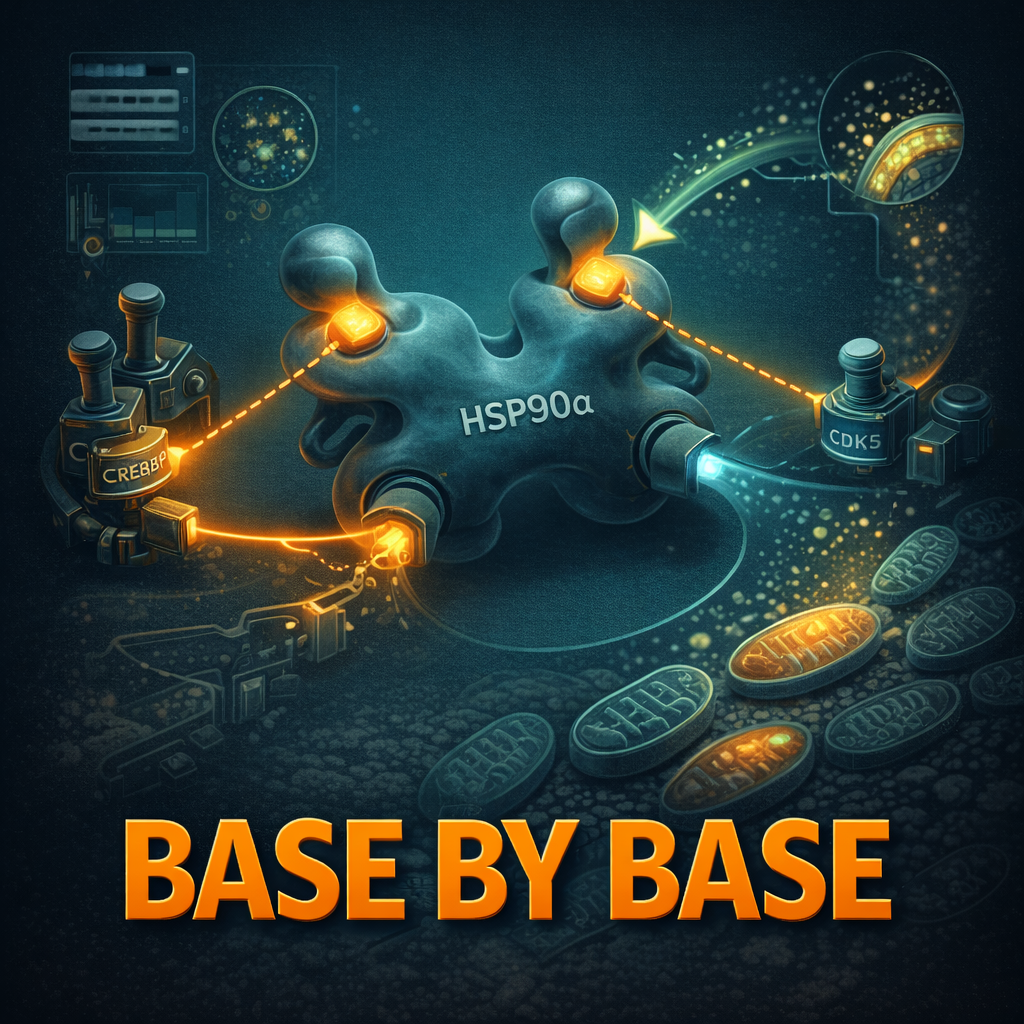
433: Lactate, HSP90α and the Mitochondrial Switch
Wu G et al., Proceedings of the National Academy of Sciences - This episode examines a PNAS study that identifies site-specific lactylation of HSP90α as a…
 Base by Base
432: Echovirus 18: Capsid opening releases the genome
Mukhamedova L et al., Proceedings of the National Academy of Sciences - Using cryo-electron tomography and single-particle cryo-EM of infected Cos-7 cells, the…
 Base by Base
431: KIAP4 and the ARND family: essential proteins for Leishmania–sand fly adhesion
Owino BO et al., Proceedings of the National Academy of Sciences - TurboID proximity labeling and proteomics identify KIAP4 as the canonical member of a…
 Base by Base
430: Proterozoic Rise: Steady Diversification of Crown Eukaryotes
Sandin MM et al., Proceedings of the National Academy of Sciences - Molecular clocks and diversification models applied to a 75,975-OTU rDNA dataset, including…
 Base by Base
429: Validating the EAGL genetic literacy measure
Barna LS et al., Human Genetics and Genomics Advances - We summarize a psychometric validation of the EAGL measure using US adult online samples. The study…
 Base by Base
428: Genetic regulation of plasma metabolites in people with HIV
Ait Oumelloul M et al., Human Genetics and Genomics Advances - Untargeted plasma metabolomics (1,930 features) in 1,244 participants of the Swiss HIV Cohort…
 Base by Base
427: When Genes Talk to Gut: Microbiome as Mediator of Metabolic Risk
Simpson RC et al., Trends in Genetics - This forum reviews evidence that host genetic variants associated with metabolic disease often overlap with loci that…
 Base by Base
426: ProtoCloud — Prototypical self-explaining model for single-cell analysis
Guo K et al., Cell Genomics - ProtoCloud is a self-explaining deep generative model that embeds single cells around cell-type-specific prototypes to deliver…
 Base by Base
425: BEAM: Bayesian reconstruction of metastatic migration histories
Staklinski SJ et al., Cell Genomics 6, 101193 (2026) - This episode explores BEAM, a Bayesian framework built on BEAST 2 that jointly infers cell-lineage…
 Base by Base
424: LECA's Ancient Interactome and Modern Disease
Cox RM et al., Cell Genomics 6, 101254 - Cox et al. reconstruct a conserved protein interaction network for the last eukaryotic common ancestor using >26,000…
 Base by Base
423: How GRN Topology Shapes the Genetic Architecture of Expression
Aguirre M et al., Cell Genomics - Aguirre et al. use simulated gene regulatory networks and a linear structural equation model to show how sparsity…
 Base by Base
422: Germline rDNA Variants and Human Complex Traits
Rodriguez-Algarra F et al., Cell Genomics - This episode examines a large-scale analysis of germline ribosomal DNA (rDNA) variation in ~500,000 UK Biobank…
 Base by Base
421: Pre-existing Cell States Predict Multi-Treatment Resistance
Schaff DL et al., Cell Genomics - Schaff et al. use multi-treatment clonal tracing combined with single-cell RNA-seq to show that rare, pre-existing…
 Base by Base
420: NOTCH2NL duplications: diversity, regulation, and human-specific changes
Real TD et al., Cell Genomics - This episode examines a long-read sequencing study that resolves the complex NOTCH2NL segmental duplications on human…
 Base by Base
419: The Single-Cell Pediatric Cancer Atlas
Hawkins AG et al., Cell Genomics - This episode summarizes Hawkins et al.'s presentation of the Single-Cell Pediatric Cancer Atlas (ScPCA) Portal, a publicly…
 Base by Base
418: Translating GWAS Across Scales
Felici B et al., Cell Genomics - A concise review of how post-GWAS methods are being used to move from statistical associations to translational insights by…
 Base by Base
417: Hidden Mosaic: Parental Postzygotic Mutations in 12,015 Trios
Garcia-Salinas OI et al., The American Journal of Human Genetics - Garcia-Salinas et al. develop a bioinformatic pipeline to recover early parental postzygotic…