Shows / CyberCode Academy
CyberCode Academy
Welcome to CyberCode Academy — your audio classroom for Programming and Cybersecurity.
🎧 Each course is divided into a series of short, focused episodes that take you from beginner to advanced level — one lesson at a time.
From Python and web development to ethical hacking and digital defense, our content transforms complex concepts into simple, engaging audio learning.
Study anywhere, anytime — and level up your skills with CyberCode Academy.
🚀 Learn. Code. Secure.
You can listen and download…
The show, from its episodes
No episode notes yet. Recurring topics, people and starter picks will appear when notes are available.
Typical episode length
18m · median of 419 episodes with a known length
Solo / guest format
Unknown — existing notes name people mentioned, but do not identify hosts or guests.
Recurring topics
No recurring topics established yet.
Recurring people
No recurring people established yet.
Start here
No starter picks yet — no published episodes with audio and a recorded notes hook.
Episodes
 CyberCode Academy
Course 27 - Hacking Web Applications, Penetration Testing, CTF | Episode 12: Introduction to Banner Grabbing and Service Fingerprinting
In this lesson, you’ll learn about: Banner grabbing (service fingerprinting), a technique used to identify open ports, running services, and version…
 CyberCode Academy
Course 27 - Hacking Web Applications, Penetration Testing, CTF | Episode 11: OSINT, Reconnaissance, and Scanning: Foundations and Tools
In this lesson, you’ll learn about: The early phases of a penetration test, focusing on intelligence gathering, infrastructure mapping, and active scanning…
 CyberCode Academy
Course 27 - Hacking Web Applications, Penetration Testing, CTF | Episode 10: OWASP Fundamentals: Top 10 Vulnerabilities and Web Security
In this lesson, you’ll learn about: Open Web Application Security Project (OWASP), an open community focused on improving software security through standards…
 CyberCode Academy
Course 27 - Hacking Web Applications, Penetration Testing, CTF | Episode 9: Tools and Techniques for Concealing Information
In this lesson, you’ll learn about: Steganography fundamentals, the practice of concealing information inside other media files such as images, audio, or video…
 CyberCode Academy
Course 27 - Hacking Web Applications, Penetration Testing, CTF | Episode 8: Cryptography Fundamentals: Encoding and Ciphers
In this lesson, you’ll learn about: Data Representation and Encoding: ASCII: Uses 128 unique values to represent text characters in computing. Base64: Encodes…
 CyberCode Academy
Course 27 - Hacking Web Applications, Penetration Testing, CTF | Episode 7: Tradecraft: The Methods and Tools of Modern Espionage
In this lesson, you’ll learn about: Tradecraft Fundamentals: The structured set of tools, techniques, and methods used in modern intelligence gathering and…
 CyberCode Academy
Course 27 - Hacking Web Applications, Penetration Testing, CTF | Episode 6: Penetration Testing Lifecycle: From Scoping to Reporting
In this lesson, you’ll learn about: The structured penetration testing lifecycle, a professional methodology that simulates real-world attacks while delivering…
 CyberCode Academy
Course 27 - Hacking Web Applications, Penetration Testing, CTF | Episode 5: Penetration Testing Terminology and Core Security Concepts
In this lesson, you’ll learn about: Core penetration testing terminology, including the difference between a vulnerability (a weakness in a system) and an…
 CyberCode Academy
Course 27 - Hacking Web Applications, Penetration Testing, CTF | Episode 4: Penetration Testing and Hacker Profiles
In this lesson, you’ll learn about: Red vs. Blue Team operations, where Red Teams simulate adversarial attacks to uncover weaknesses, and Blue Teams defend…
 CyberCode Academy
Course 27 - Hacking Web Applications, Penetration Testing, CTF | Episode 3: Metasploit Database Setup and Initialization
In this lesson, you’ll learn about: Preparing the Metasploit lab environment by configuring its required backend database components. Starting the PostgreSQL…
 CyberCode Academy
Course 27 - Hacking Web Applications, Penetration Testing, CTF | Episode 2: Linux Fundamentals and Command Injection Basics
In this lesson, you’ll learn about: Linux operating system fundamentals, including its architecture and why command-line proficiency is critical for…
 CyberCode Academy
Course 27 - Hacking Web Applications, Penetration Testing, CTF | Episode 1: Kali Linux Essentials
In this lesson, you’ll learn about: Kali Linux, a Unix-like operating system designed for penetration testing and security assessments, preloaded with hundreds…
 CyberCode Academy
Course 26 - Assessing and Mitigating Security Risks | Episode 5: Essential Tools for Incident Response
In this lesson, you’ll learn about: Building a digital forensics “utility belt” using open-source and low-cost tools to support incident response and…
 CyberCode Academy
Course 26 - Assessing and Mitigating Security Risks | Episode 4: A Guide to Mitigation and Security Controls
In this lesson, you’ll learn about: Core mitigation strategies and layered security controls used to defend modern network infrastructures against evolving…
 CyberCode Academy
Course 26 - Assessing and Mitigating Security Risks | Episode 3: Foundations of Successful Incident Identification and Response Management
In this lesson, you’ll learn about: How to shift from reactive to proactive security by using intrusion detection tools and manually analyzing network logs to…
 CyberCode Academy
Course 26 - Assessing and Mitigating Security Risks | Episode 2: The Fundamentals of Organizational Risk Management
In this lesson, you’ll learn about: The Foundations of Organizational Risk Management Why security must begin with understanding a system’s requirements…
 CyberCode Academy
Course 26 - Assessing and Mitigating Security Risks | Episode 1: Threats, Mindsets, and Vulnerabilities
In this lesson, you’ll learn about: The Modern Cybersecurity Landscape How cybersecurity has evolved from an IT-only concern into a shared responsibility for…
 CyberCode Academy
Course 25 - API Python Hacking | Episode 7: Building Windows Executables from Python Scripts with PyInstaller
In this lesson, you’ll learn about: Converting Python Scripts into Executables Installing and using PyInstaller to package Python code into standalone .exe…
 CyberCode Academy
Course 25 - API Python Hacking | Episode 6: Privilege Modification and User Impersonation
In this lesson, you’ll learn about: Programmatic Privilege Modification How to use the AdjustTokenPrivileges API to enable or disable specific privileges…
 CyberCode Academy
Course 25 - API Python Hacking | Episode 5: Managing and Verifying Process Privileges
In this lesson, you’ll learn about: Fundamentals of Windows Access Tokens Tokens define a process's privileges, such as shutting down the system or debugging…
 CyberCode Academy
Course 25 - API Python Hacking | Episode 4: Structures, Process Spawning, and Undocumented Calls
In this lesson, you’ll learn about: Defining Windows Internal Structures in Python Representing structures like PROCESS_INFORMATION and STARTUPINFO using…
 CyberCode Academy
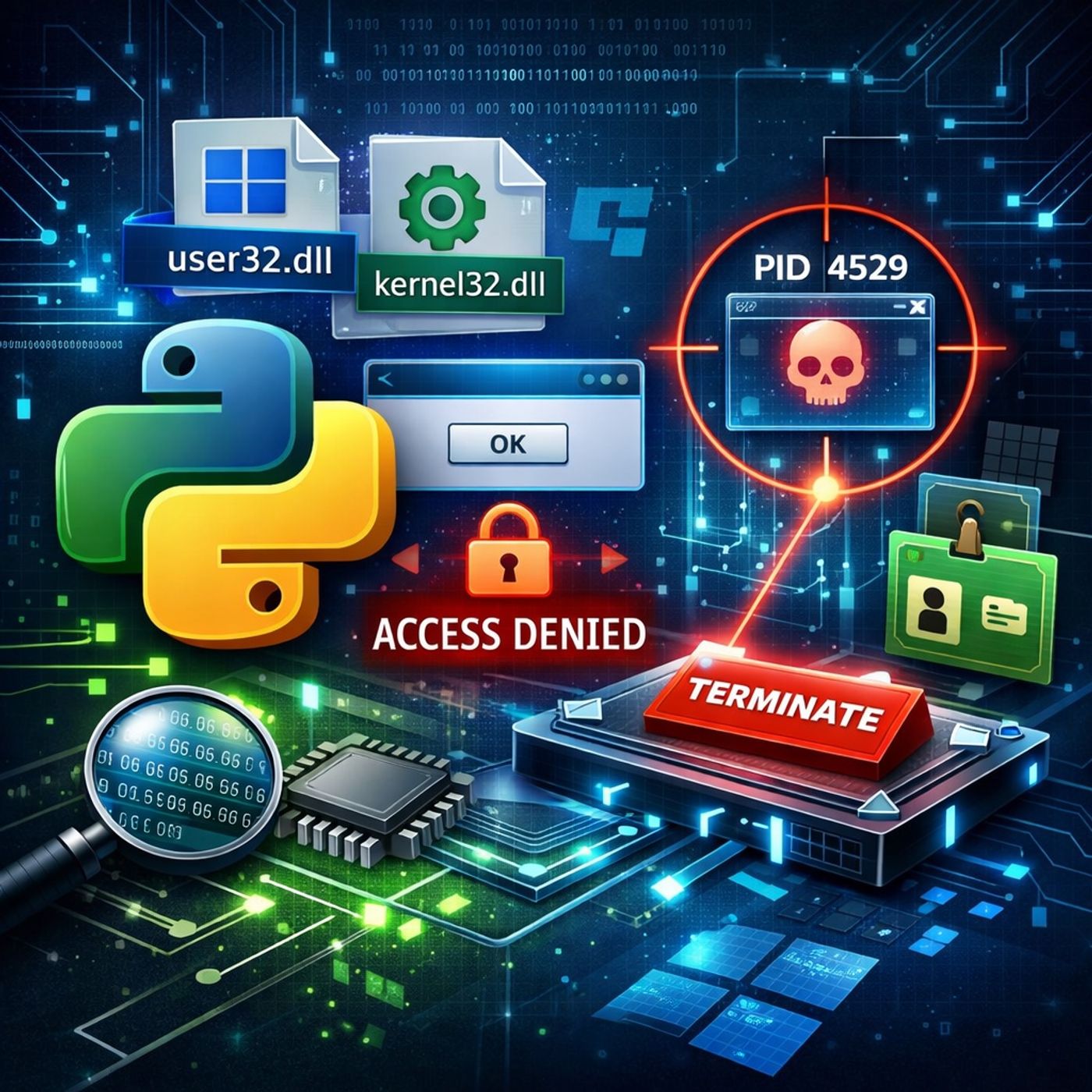
Course 25 - API Python Hacking | Episode 3: From ctypes Basics to Building a Process Killer
In this lesson, you’ll learn about: Interfacing Python with Windows API using ctypes Loading core DLLs: user32.dll and kernel32.dll Executing basic functions…
 CyberCode Academy
Course 25 - API Python Hacking | Episode 2: Foundations of Windows Internals and API Mechanisms
In this lesson, you’ll learn about: Fundamentals of Windows Processes and Threads A process is a running program with its own virtual memory space Threads are…
 CyberCode Academy
Course 25 - API Python Hacking | Episode 1: GitHub Portfolio Building and Environment Setup
In this lesson, you’ll learn about: Building a Professional Portfolio Creating a GitHub account and configuring it for public repositories Initializing…
 CyberCode Academy
Course 24 - Machine Learning for Red Team Hackers | Episode 6: Security Vulnerabilities in Machine Learning
In this lesson, you’ll learn about: The major security threat categories in machine learning: model stealing, inversion, poisoning, and backdoors How model…
 CyberCode Academy
Course 24 - Machine Learning for Red Team Hackers | Episode 5: The Complete Guide to Deepfake Creation
In this lesson, you’ll learn about: What deepfakes are and how neural networks enable face, voice, and style transfer The standard face swap pipeline…
 CyberCode Academy
Course 24 - Machine Learning for Red Team Hackers | Episode 4: Mastering White-Box and Black-Box Attacks
In this lesson, you’ll learn about: The difference between white-box and black-box threat models in machine learning security Why gradient-based models are…
 CyberCode Academy
Course 24 - Machine Learning for Red Team Hackers | Episode 3: Evading Machine Learning Malware Classifiers
In this lesson, you’ll learn about: What adversarial machine learning is and why ML-based malware classifiers are vulnerable to manipulation The difference…
 CyberCode Academy
Course 24 - Machine Learning for Red Team Hackers | Episode 2: Building and Implementing Evolutionary Testing Tools
In this lesson, you’ll learn about: What fuzzing is and why it’s a powerful technique for discovering software vulnerabilities The difference between basic…
 CyberCode Academy
Course 24 - Machine Learning for Red Team Hackers | Episode 1: Building an Automated CAPTCHA-Breaking Bot
In this lesson, you’ll learn about: How CAPTCHA systems (like Really Simple CAPTCHA for WordPress) are designed to prevent automated abuse The role of…
 CyberCode Academy
Course 23 - WiFi Hacking with Raspberry Pi | Episode 7: Building a Digital Ghost on Raspberry Pi
In this lesson, you’ll learn about: What digital identity is and how IP and MAC addresses are used to track users Why masking an IP address is essential for…
 CyberCode Academy
Course 23 - WiFi Hacking with Raspberry Pi | Episode 6: Fix These 5 Router Security Loopholes
In this lesson, you’ll learn about: Why default router settings are a major security risk and commonly targeted by attackers How changing the administrative IP…
 CyberCode Academy
Course 23 - WiFi Hacking with Raspberry Pi | Episode 5: Cracking Wi-Fi Passwords With Raspberry Pi
In this lesson, you’ll learn about: Using a Raspberry Pi as a mobile platform for wireless penetration testing Leveraging Wifite, an automated tool for…
 CyberCode Academy
Course 23 - WiFi Hacking with Raspberry Pi | Episode 4: WiFi Jamming Techniques Using Raspberry
In this lesson, you’ll learn about: How a Raspberry Pi can be configured as a portable wireless security lab Methods for remotely accessing a headless…
 CyberCode Academy
Course 23 - WiFi Hacking with Raspberry Pi | Episode 3: Build a Portable Raspberry Pi Cyberdeck
In this lesson, you’ll learn about: How to convert a standard Raspberry Pi into a portable penetration testing device The required hardware components…
 CyberCode Academy
Course 23 - WiFi Hacking with Raspberry Pi | Episode 2: Building The Perfect Raspberry Pi Hacking Kit
In this lesson, you’ll learn about: The purpose of this segment as a preparation and logistics guide for working with single-board computers Where to acquire…
 CyberCode Academy
Course 23 - WiFi Hacking with Raspberry Pi | Episode 1: Raspberry Pi Desktop And Hacking Machine
In this lesson, you’ll learn about: What a Raspberry Pi is and why it’s described as a low-cost, credit-card-sized single-board computer How installing an…
 CyberCode Academy
Course 22 - Digital Forensics: RAM Extraction Fundamentals | Episode 5: Forensic Access and RAM Extraction with Inception
In this lesson, you’ll learn about: The forensic purpose of Inception for accessing live, locked systems without powering them down Why volatile memory…
 CyberCode Academy
Course 22 - Digital Forensics: RAM Extraction Fundamentals | Episode 4: RAM Capture via Magnet and FTK Imager
In this lesson, you’ll learn about: A technical overview of memory acquisition using Magnet RAM Capture and FTK Imager How RAM footprint size affects evidence…
 CyberCode Academy
Course 22 - Digital Forensics: RAM Extraction Fundamentals | Episode 3: Comparing Belkasoft and Magnet Tools
In this lesson, you’ll learn about: The role of RAM acquisition in digital forensics and why volatile memory is critical evidence How benchmarking RAM…
 CyberCode Academy
Course 22 - Digital Forensics: RAM Extraction Fundamentals | Episode 2: Benchmarking Tools and Using MoonSols DumpIt
In this lesson, you’ll learn about: Why Benchmarking RAM Extraction Tools Matters How benchmarking supports defensible tool selection in forensic…
 CyberCode Academy
Course 22 - Digital Forensics: RAM Extraction Fundamentals | Episode 1: Value, Strategy, and Technical Preparation
In this lesson, you’ll learn about: Why RAM Is Critical Forensic Evidence How volatile memory captures data that never touches disk and is lost on shutdown…
 CyberCode Academy
Course 21 - Digital Forensics: Windows Shellbags | Episode 5: Shellbags Forensics: Validating Network Drive Activity
In this lesson, you’ll learn about: Validating Network Drive Activity with Shellbags How Windows Shellbags act as a silent witness for user interaction with…
 CyberCode Academy
Course 21 - Digital Forensics: Windows Shellbags | Episode 4: Shellbag Forensics: Tracking USB Device History and Artifact Validation
In this lesson, you’ll learn about: USB Forensics Using Shellbag Artifacts How Windows Shellbags can be leveraged to reconstruct user interaction with…
 CyberCode Academy
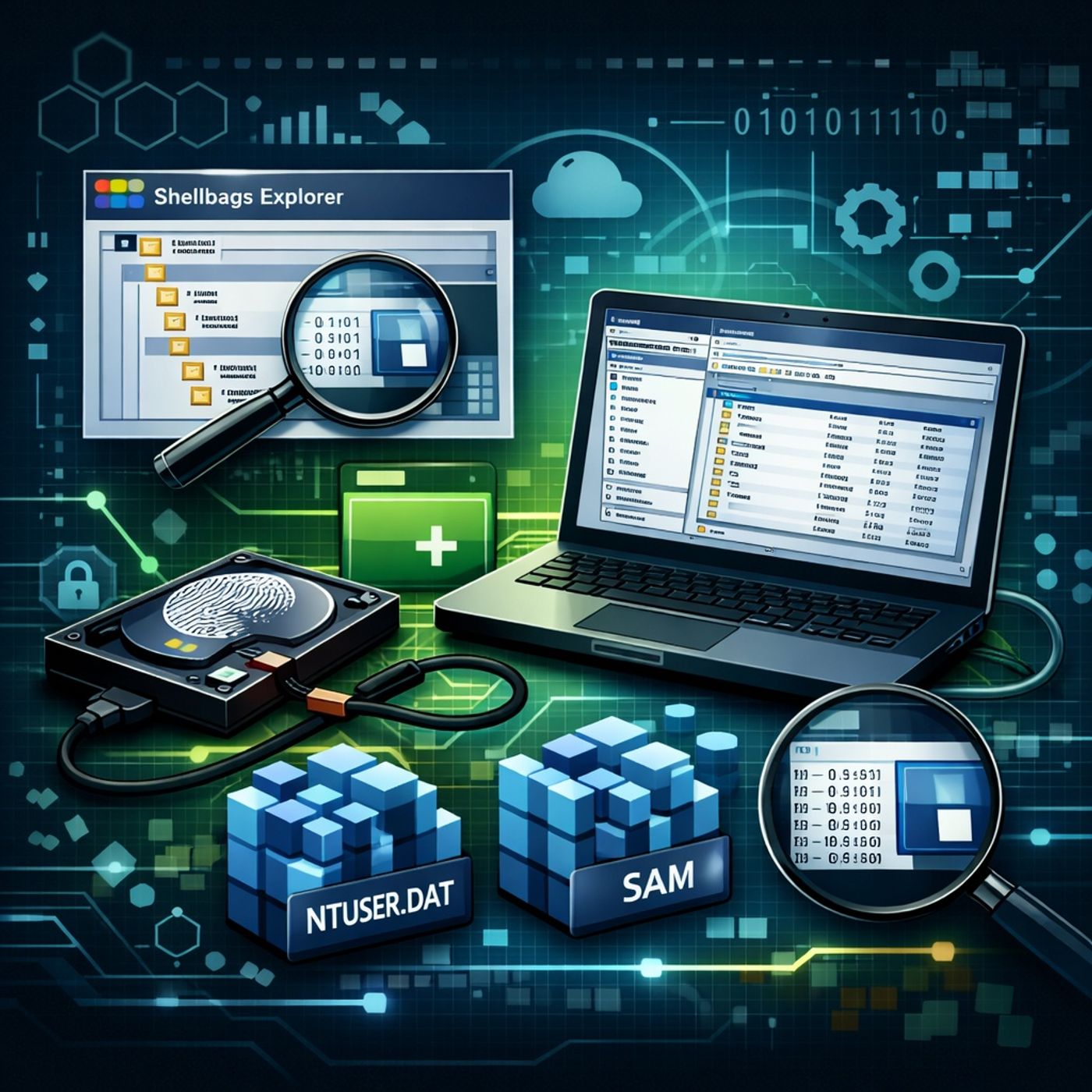
Course 21 - Digital Forensics: Windows Shellbags | Episode 3: ShellBag Forensics: Practical Validation and Timestamp Analysis
In this lesson, you’ll learn about: Practical ShellBag Forensics Workflow How ShellBags function as registry-based artifacts that record user folder…
 CyberCode Academy
Course 21 - Digital Forensics: Windows Shellbags | Episode 2: Forensic System Setup and Local Drive Integration
In this lesson, you’ll learn about: Preparing a Forensic Workstation The purpose of using a controlled forensic setup to safely extract and analyze system…
 CyberCode Academy
Course 21 - Digital Forensics: Windows Shellbags | Episode 1: Windows Shellbags: Forensic Fundamentals and Deep Dive Analysis
In this lesson, you’ll learn about: What Windows Shellbags Are and Why They Matter How shellbags are registry-based artifacts created by Windows Explorer to…
 CyberCode Academy
Course 20 - Malware Analysis: Identifying and Defeating Code Obfuscation | Episode 5: Identifying and Analyzing Cryptography in Malware
In this lesson, you’ll learn about: Why Malware Uses Cryptography and Encoding How encryption and encoding are used to conceal payloads, configuration data…
 CyberCode Academy
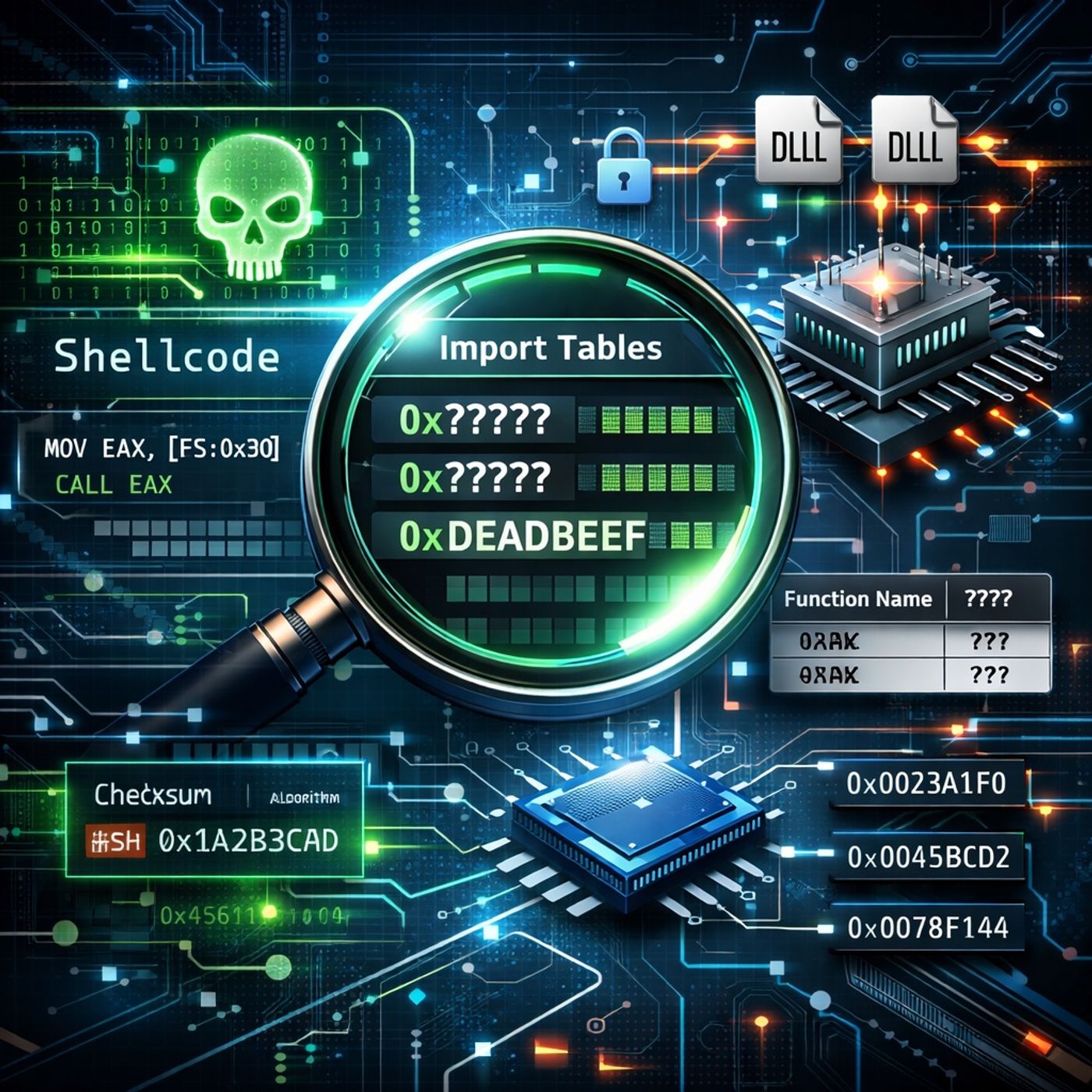
Course 20 - Malware Analysis: Identifying and Defeating Code Obfuscation | Episode 4: Dynamic API Resolution: Walking the PEB and Parsing
In this lesson, you’ll learn about: Why Malware Builds Its Own Import Tables How bypassing static, dynamic, and runtime linking hides API usage from analysis…
 CyberCode Academy
Course 20 - Malware Analysis: Identifying and Defeating Code Obfuscation | Episode 3: Analyzing and Defeating String Obfuscation in Native
In this lesson, you’ll learn about: String Obfuscation in Native Malware: Why string analysis is significantly harder in native code compared to interpreted…
 CyberCode Academy
Course 20 - Malware Analysis: Identifying and Defeating Code Obfuscation | Episode 2: Analyzing and Defeating Obfuscation in VBA
In this lesson, you’ll learn about: Obfuscation in Interpreted Code: Why interpreted languages like VBA and PowerShell are still heavily obfuscated despite…
 CyberCode Academy
Course 20 - Malware Analysis: Identifying and Defeating Code Obfuscation | Episode 1: Defeating Malware Obfuscation: Fundamentals, Impact
In this lesson, you’ll learn about: The Purpose of Code Obfuscation: Defining obfuscation as the practice of intentionally making software difficult to read or…
 CyberCode Academy
Course 19 - Ultimate Rust Crash Course | Episode 5: Rust Concurrency Fundamentals: Closures, Threads, and Channel Communication
In this lesson, you’ll learn about: Functional Programming with Closures: Defining closures as anonymous functions that capture values from their surrounding…
 CyberCode Academy
Course 19 - Ultimate Rust Crash Course | Episode 4: Rust Foundations: Structs, Traits, Collections
In this lesson, you’ll learn about: Data Organization with Structs and Traits: Using structs to group data fields, methods, and associated functions. Defining…
 CyberCode Academy
Course 19 - Ultimate Rust Crash Course | Episode 3: Rust Fundamentals: Mastering Ownership, References, and Borrowing
In this lesson, you’ll learn about: Ownership and Memory Management in Rust: How Rust guarantees memory safety without a garbage collector. The difference…
 CyberCode Academy
Course 19 - Ultimate Rust Crash Course | Episode 2: Rust Core Foundations: Data Types, Control Flow, and String Handling
In this lesson, you’ll learn about: Core Data Representations in Rust: Scalar types: integers (signed i and unsigned u), floating-point types (f32, f64)…
 CyberCode Academy
Course 19 - Ultimate Rust Crash Course | Episode 1: Rust Programming Foundations: From Cargo Tooling to Core Syntax and Modules
In this lesson, you’ll learn about: The Rust Ecosystem and Tooling: Using Cargo as Rust’s package manager, build system, and documentation tool. Creating…
 CyberCode Academy
Course 18 - Evading IDS Firewalls and Honeypots | Episode 6: Mastering Malware Evasion: Stealth, Obfuscation, and Anti-Analysis
In this lesson, you’ll learn about: Evading Initial Detection: Payload Obfuscation: Encoding payloads multiple times to cloak them from IDS detection. Benign…
 CyberCode Academy
Course 18 - Evading IDS Firewalls and Honeypots | Episode 5: Intrusion Detection and Prevention: Strategies, Tools, and Intelligence
In this lesson, you’ll learn about: Foundations of Intrusion Defense: Multi-layered defense-in-depth strategies using models like SAPSA. Difference between…
 CyberCode Academy
Course 18 - Evading IDS Firewalls and Honeypots | Episode 4: Advanced Application Security: WAFs, API Gateways, and Honeypot Traps
In this lesson, you’ll learn about: Web Application Firewalls (WAFs): Protecting the application layer by inspecting HTTP/HTTPS and WebSocket traffic. Breaking…