Shows / The Long Way Back to Ourselves
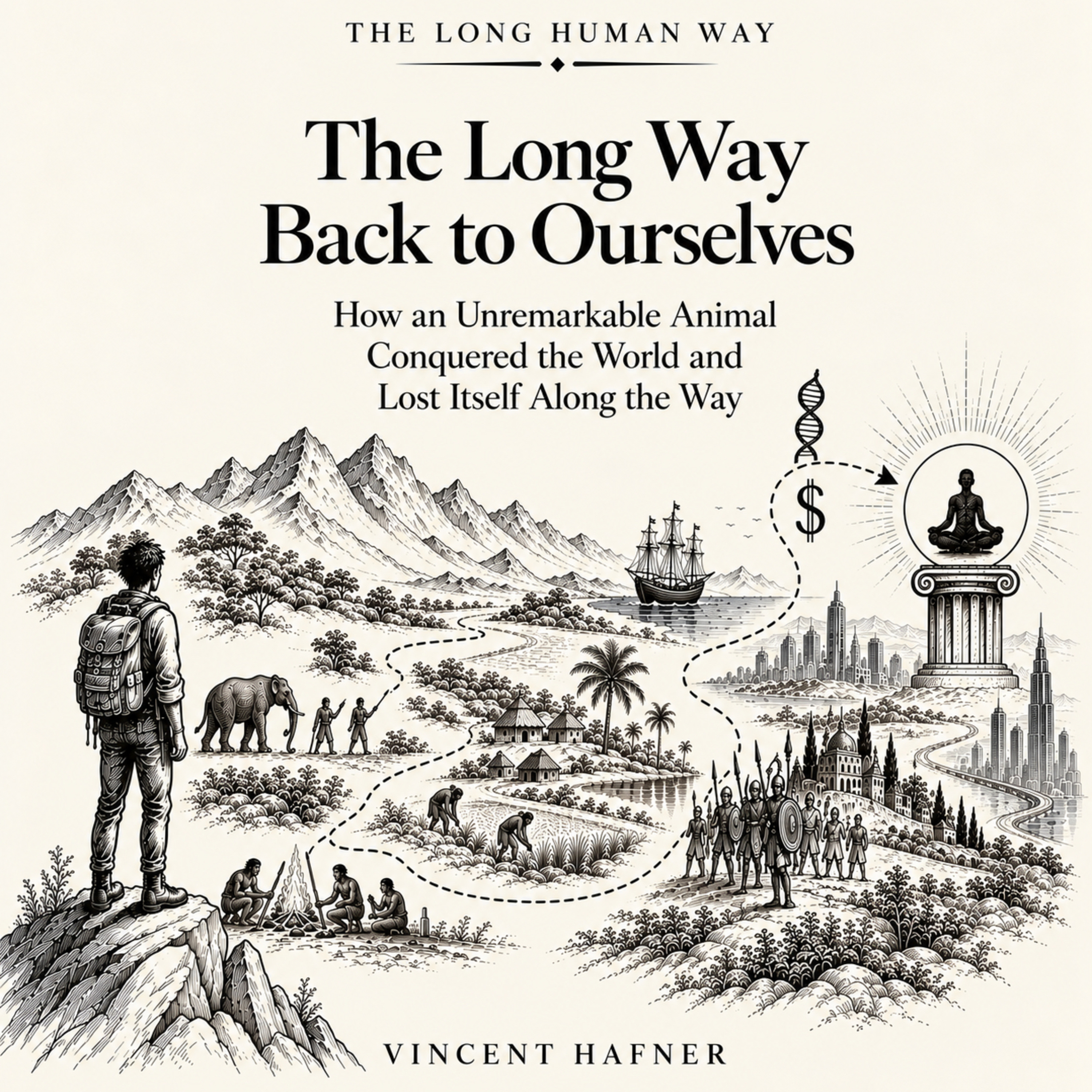
The Long Way Back to Ourselves
How an Unremarkable Animal Conquered the World and Lost Itself Along the Way (Concept, structure and editing from Author. Text and voice were generated with AI.
The show, from its episodes
No episode notes yet. Recurring topics, people and starter picks will appear when notes are available.
Typical episode length
33m · median of 74 episodes with a known length
Solo / guest format
Unknown — existing notes name people mentioned, but do not identify hosts or guests.
Recurring topics
No recurring topics established yet.
Recurring people
No recurring people established yet.
Start here
No starter picks yet — no published episodes with audio and a recorded notes hook.
Episodes
- The Long Way Back to Ourselves
8.4 - The Hard Problem
This episode starts from Thomas Nagel's 1974 question "What is it like to be a bat?" and separates four states everyday language mixes together: wakefulness…
- The Long Way Back to Ourselves
8.2 - The Narrating Self: Why We Live Memories, Not Experiences
This episode starts from a 1993 cold-water experiment by Daniel Kahneman and colleagues: people remember not the sum of an experience but its peak and its end…
- The Long Way Back to Ourselves
8.1 - The Invention of the Individual
This episode asks whether the modern individual is a core that was always there or something historically assembled. It corrects Jacob Burckhardt's 1860 image…
- The Long Way Back to Ourselves
7.10 - Density: The Great Acceleration
This episode opens on a mountain in the Pacific in March 1958, where chemist Charles David Keeling began measuring atmospheric carbon dioxide at roughly 315…
- The Long Way Back to Ourselves
7.9 - Decolonization: The Invention of a Hundred and Fifty States
This episode follows the night more than a hundred times between 1945 and the early 1990s when one flag came down and another went up, while the infrastructure…
- The Long Way Back to Ourselves
7.8 - The World Under Deterrence
This episode challenges the name "Cold War" itself, pointing out that while the two superpowers never fought each other directly between 1945 and 1991, several…
- The Long Way Back to Ourselves
7.7 - The Second World War and the Bomb
This episode follows the global scope of the Second World War, starting in China in 1937 rather than Europe in 1939, where the war alone cost an estimated…
- The Long Way Back to Ourselves
7.6 - The Holocaust: The Question No Explanation Closes
This episode works through the administrative record of the Holocaust, starting with the Wannsee Conference of January 1942, where fifteen officials spent…
- The Long Way Back to Ourselves
7.5 - Totalitarianism: When an Idea Takes Over the State
This episode opens with a representative scene of a 1920s registration clerk filling out a form, drawing Hannah Arendt's distinction between an ordinary…
- The Long Way Back to Ourselves
7.4 - The First World War: The End of a World Order
This episode reconstructs the thirty-one days between the assassination of Archduke Franz Ferdinand in Sarajevo and the outbreak of a war that six great powers…
- The Long Way Back to Ourselves
7.3 - The Three Branches: Liberal, Socialist, Evolutionary
This episode follows a single unsettling fact: Sweden, a functioning democracy with a free press and independent courts, forcibly sterilized roughly 63,000…
- The Long Way Back to Ourselves
7.2 - Humanism: Authority Migrates into the Person
This episode traces how the question of what is true and right, answered outside the person, collapsed among Europe's educated classes by the time Nietzsche…
- The Long Way Back to Ourselves
7.1 - Nationalism: The Imagined Community
This episode looks at how a passport decides whether you may cross a border, work, or vote. You learn why belonging to a nation feels older than it is…
- The Long Way Back to Ourselves
6.10 - Compression: The Clock, the Factory, and Consumption
This episode tests the familiar story that factories invented clock discipline, tracing it to E.P. Thompson's 1967 essay, and shows it fails its own test: a…
- The Long Way Back to Ourselves
6.9 - The Industrial Revolution: Energy in Abundance
This episode measures the industrial revolution in efficiency numbers you can check against each other: Newcomen's 1712 steam engine converted about half a…
- The Long Way Back to Ourselves
6.8 - Adam Smith and the Invention of Economics
This episode checks what Adam Smith wrote against what gets attributed to him: "the invisible hand" appears three times in his published work, once in The…
- The Long Way Back to Ourselves
6.7 - Capital and Credit: How Trust in the Future Creates the Present
This episode opens with a Genoese notary's register from 1154 to 1164, the oldest surviving in Europe, showing you how merchants pooled money and risk for…
- The Long Way Back to Ourselves
6.6 - Enlightenment and Its Opponents
This episode follows what happened after a single sentence, resolved in Versailles on 26 August 1789, declaring that men are born free and equal in rights, and…
- The Long Way Back to Ourselves
6.5 - The Needham Question: Why Not China, Not India, Not the Caliphate?
This episode takes on the Needham Question, named for biochemist Joseph Needham, who documented that China had movable type, gunpowder and cast iron centuries…
- The Long Way Back to Ourselves
6.4 - The Scientific Revolution: The Admission of Ignorance
This episode is about the moment it became acceptable to say publicly that an answer was not written in any existing book, traced through Francis Bacon's 1620…
- The Long Way Back to Ourselves
6.3 - How Should We Live? Three Operating Systems of Morality
This episode uses the trolley problem, devised by Philippa Foot in 1967, to test whether you actually judge by three separate moral systems, character, rule…
- The Long Way Back to Ourselves
6.2 - Kant: The Turn Inward
This episode follows how you get from Hume's challenge to Kant's answer, published in 1781 as the Critique of Pure Reason after eleven years of near silence…
- The Long Way Back to Ourselves
6.1 - What Can We Know? From Socrates to Hume
This episode traces what you can actually know, from Socrates questioning Athenians in the marketplace to David Hume's 1748 argument that nothing guarantees…
- The Long Way Back to Ourselves
5.10 - Compression: Silver, Sugar, Slaves, and the First World Market
This episode follows the Atlantic slave trade as a financial system, arguing the schoolbook "triangular trade" picture hides a denser network of direct…
- The Long Way Back to Ourselves
5.9 - Colonialism: The Mechanics of Rule at a Distance
This episode examines colonial rule as an administrative system, opening with the fact that roughly a third of Africa's land borders run in straight lines…
- The Long Way Back to Ourselves
5.8 - The Printing Press: When Copying Became Cheap
This episode traces how, within fifty years of Gutenberg, thirty thousand editions had been printed in Europe, correcting the claim China simply failed to…
- The Long Way Back to Ourselves
5.7 - The Islamic Science System
This episode follows scholar Ibn al-Haytham, who in 11th-century Cairo used a darkened room with a pinhole and oil lamps to show light travels from objects…
- The Long Way Back to Ourselves
5.6 - Africa Before Colonialism
This episode surveys West African, East African, and southern African polities before European colonial rule and asks why so few can be named offhand. You…
- The Long Way Back to Ourselves
5.5 - Epidemics, Part Two: The Biological Collapse of the Americas
This episode asks how fewer than two hundred Spaniards toppled an empire fielding tens of thousands of troops, rejecting "superior weapons" and "betrayal" as…
- The Long Way Back to Ourselves
5.4 - Fourteen Ninety-Two: The Exchange That Rebuilt the World
This episode follows what actually crossed the Atlantic after 1492, not just conquest, but plants, animals, and pathogens that reshaped both hemispheres' diets…
- The Long Way Back to Ourselves
5.3 - The Other Seafarers: Phoenicians, Arabs, Chinese, Vikings
This episode takes you through Phoenician, Arab, Chinese, and Norse seafaring to ask why none produced a lasting worldwide network the way 15th-century…
- The Long Way Back to Ourselves
5.2 - The Polynesians: Humanity's Greatest Feat of Navigation
This episode takes you through how Polynesian navigators crossed thousands of kilometers of open Pacific without instruments, writing, or maps, reading…
- The Long Way Back to Ourselves
5.1 - Epidemics, Part One: The Price of Density
This episode shows why fast-spreading diseases such as measles and smallpox are not something civilization suffers from outside but one of its own products. It…
- The Long Way Back to Ourselves
4.10 - Compression: Intoxication, Ritual, and the Chemistry of Culture
This episode opens with the oldest chemical evidence of a fermented drink, a nine-thousand-year-old residue of rice, honey, and fruit at Jiahu, China, raising…
- The Long Way Back to Ourselves
4.9 - Music: Synchronizing the Group
This episode defines entrainment, the ability not just to move to a beat but to anticipate it, and you learn it appears in infants and every society with no…
- The Long Way Back to Ourselves
4.8 - Art: Why Humans Make Images
This episode opens with a signed Greek vase from the sixth century BCE reading "Exekias made me and painted me," and you learn the rarity of a maker's name…
- The Long Way Back to Ourselves
4.7 - Death: Burial, Mourning, the Afterlife
This episode opens with an Egyptian shabti figure inscribed to answer for its owner's forced labor in the afterlife, showing descriptions of death are almost…
- The Long Way Back to Ourselves
4.6 - Emotions: Universal or Constructed?
This episode examines Paul Ekman's studies in New Guinea, which used forced-choice lists of six emotion words to claim facial expressions are universal, and…
- The Long Way Back to Ourselves
4.5 - Love, Marriage, and the Invention of Togetherness
This episode starts from the reality that marriage, for most of history, was a contract between families over land and inheritance, not a bond built on…
- The Long Way Back to Ourselves
4.4 - The Invention of Childhood
This episode starts with the fact that a woman needed five to seven children to hold a population steady, then tests historian Philippe Ariès's claim that…
- The Long Way Back to Ourselves
4.3 - Slavery: The Longest Institution
This episode opens with a Roman sale contract in which a seller had to guarantee a woman's health and disclose any tendency to run away, the same language used…
- The Long Way Back to Ourselves
4.2 - War: The Organization of Violence
This episode traces the archaeological evidence for organized violence, starting with a 13,000-year-old cemetery on the Nile where healed and fresh stone-point…
- The Long Way Back to Ourselves
4.1 - Us and Them: The Psychology of the Group
This episode examines why humans sort each other into in-groups and out-groups so easily, using Henri Tajfel's 1970s Bristol experiments in which boys given an…
- The Long Way Back to Ourselves
3.10 - Compression: Monotheism and Its Price
This episode opens with an inscribed pottery shard from a Sinai station, dated to around 800 BCE, blessing its recipient by a god's name alongside a second…
- The Long Way Back to Ourselves
3.9 - India Thinks: The Self, Suffering, and the Wheel
The episode opens with a precisely regulated Vedic fire sacrifice, whose outcome depends on correct performance rather than intention, tracing how the…
- The Long Way Back to Ourselves
3.8 - China Thinks: Confucius, Laozi, and the Legalists
This episode follows three rival Chinese answers to the collapse of Zhou order, opening with a parable from Legalist thinker Han Feizi about a farmer who…
- The Long Way Back to Ourselves
3.7 - The Axial Age: When the World Began Thinking at the Same Time
The episode tests the claim, named by philosopher Karl Jaspers in 1949, that Greece, Israel, Persia, India, and China independently produced a new kind of…
- The Long Way Back to Ourselves
3.6 - From Ancestors to the Great Gods
This episode asks why the oldest known gods showed little interest in whether people cheated each other, while today's largest religions treat morality as…
- The Long Way Back to Ourselves
3.5 - The First Networks: Bronze, Incense, Silk
The episode centers on the Uluburun shipwreck, a fourteenth-century-BCE vessel off the Turkish coast carrying roughly ten tons of copper and a ton of tin, the…
- The Long Way Back to Ourselves
3.4 - Money: The Most Successful Fiction of All Time
This episode dismantles the textbook story that money arose to fix barter's inefficiencies: for roughly two thousand years, Babylonian accounts were kept in…
- The Long Way Back to Ourselves
3.3 - The Empire as Operating System
The episode compares how ancient empires ruled across distances no one could travel: Herodotus describes a Persian royal-road message crossing roughly 2,500…
- The Long Way Back to Ourselves
3.2 - Bureaucracy: How the State Learned to See
This episode follows how forests and people get turned into administrative categories, centered on anthropologist James Scott's 1998 study Seeing Like a State…
- The Long Way Back to Ourselves
3.1 - The Law: From Hammurabi to the Idea of the Rule
The episode examines the Code of Hammurabi, the roughly 3,750-year-old Babylonian stone in the Louvre, testing whether a written law binds the ruler who issued…
- The Long Way Back to Ourselves
2.10 - Compression: Patriarchy, the Hardest Case
This episode treats the subordination of women as history's hardest case of inequality: it appears in nearly every society you can name yet had a beginning…
- The Long Way Back to Ourselves
2.9 - How Inequality Arises, and Why It Always Passes Itself Off as Nature
This episode explains that hunter-gatherer equality was not a default state but active work: Boehm's reverse dominance hierarchy, where groups keep anyone from…
- The Long Way Back to Ourselves
2.8 - Writing: When Information Left the Brain
This episode traces writing to its origin: the oldest surviving texts from Uruk, around 3300 BCE, are not prayers but inventories of barley, sheep, and beer…
- The Long Way Back to Ourselves
2.7 - The Anunnaki: What the Tablets Say, and What Was Made of It
This episode reads the Babylonian creation text known as the Epic of Atrahasis, in which lesser gods strike over forced labor before humans are created from…
- The Long Way Back to Ourselves
2.6 - Sumer: Why There, Why Then
This episode explains why the world's first cities arose on a Mesopotamian plain that had almost nothing you'd think a civilization needs: no stone, timber, or…
- The Long Way Back to Ourselves
2.5 - The First City: Çatalhöyük, Jericho, Uruk
This episode compares three sites — Çatalhöyük, Jericho, and Uruk — to ask when a large settlement actually becomes a city, and the answer corrects a common…
- The Long Way Back to Ourselves
2.4 - Domestication: Who Actually Tamed Whom
This episode flips the usual domestication story, asking whether humans tamed animals and plants, or were reshaped as much as they reshaped them. It draws on a…