267: DNA base-pair opening modes and soliton-like loops revealed by hydrogen exchange
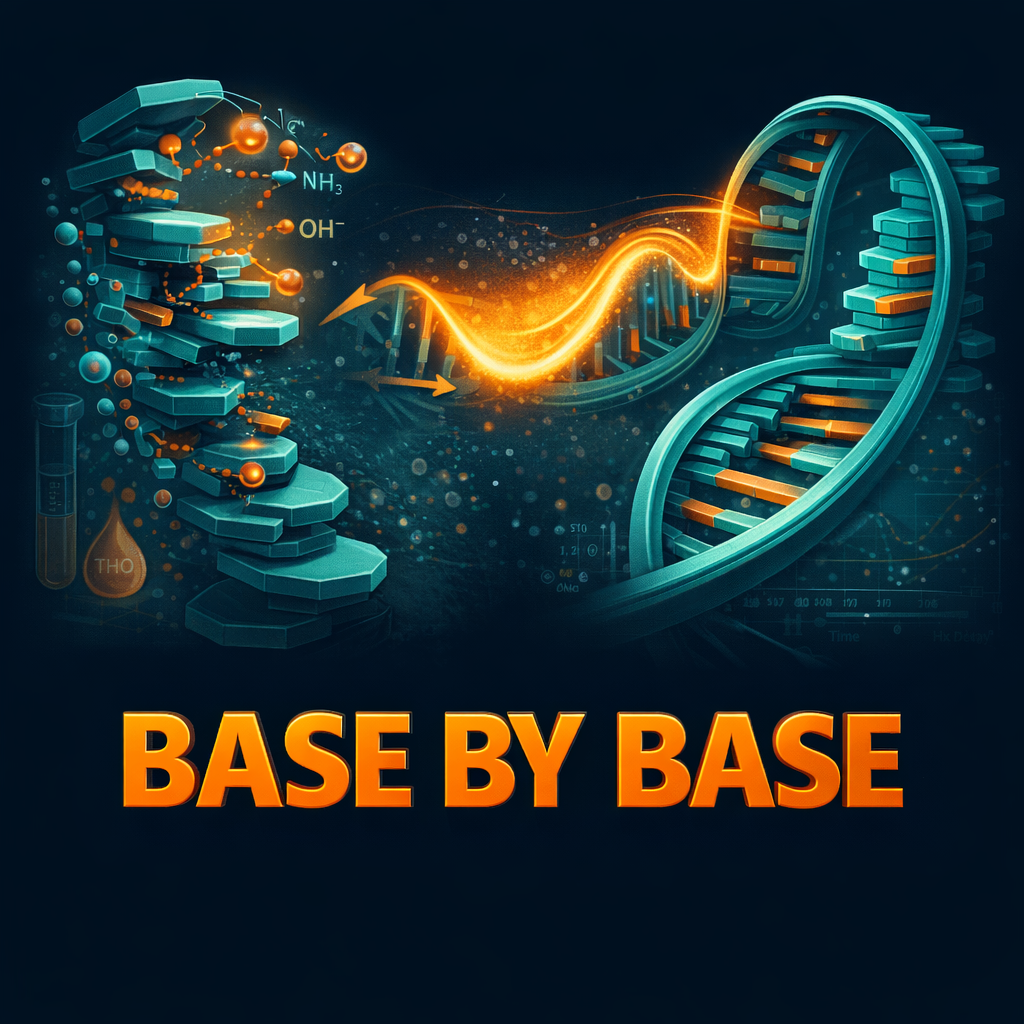
Englander SW et al., Proc. Natl. Acad. Sci. U.S.A. 2026.123:e2520855122 - Hydrogen exchange (H-T and NMR H-H) on DNA and RNA reveals two distinct base-pair opening modes: single-base microsecond openings and multi-base millisecond soliton-like loops. Key terms: hydrogen exchange, DNA dynamics, base pair opening, soliton, H-T exchange.
Study Highlights:
Systems studied include long polynucleotides (DNA, duplex RNA, synthetic long duplexes) and short oligonucleotides; key methods are H-T (tritium) exchange, stopped-flow H-D, and NMR H-H (water relaxation) measurements. H-T exchange of long…
Read the full description
polymers reports opening-limited EX1 imino exchange with kop ~1/s, reclosing kcl ~20/s and Kop ~10^-2 consistent with multi-base open loops with ms lifetimes. NMR H-H on short oligos reports catalyzable EX2 behavior dominated by single base-pair openings with kcl ~10^6/s and Kop ~10^-6 and microsecond lifetimes. The selective detection implies short oligonucleotides cannot host extensive loops while multi-base soliton-like loops in polynucleotides could dynamically expose sequences for protein or nucleic acid recognition.
Conclusion:
Both H-T and NMR H-H exchange provide accurate but complementary views: long polynucleotides exhibit frequent multi-base, ms-lived open loops (Kop ~10^-2, kcl ~20/s) while short oligonucleotides reveal rare single-base, μs-lived openings (Kop ~10^-6, kcl ~10^6/s).
QC:
This episode was checked against the original article PDF and publication metadata for the episode release published on 2026-01-22.
QC Scope:
- article metadata and core scientific claims from the narration
- excludes analogies, intro/outro, and music
- transcript coverage: Audited transcript portions describing hydrogen exchange theory, EX1/EX2, the two base-pair opening modes, the soliton traveling loop hypothesis, length dependence, and biological implications as presented in the article.
- transcript topics: Hydrogen exchange theory and Eigen proton-transfer foundations; H-T exchange in long polynucleotides (1000+ bp) and EX1 vs EX2 interpretation; H-H exchange by NMR in short oligonucleotides and its constraints; Two base-pair opening modes: single-base openings (EX1-dominated) and multi-base open loops (EX2-dominated); Soliton traveling loop hypothesis and migration along DNA; Length dependence reconciles datasets (native long DNA vs short oligonucleotides)
QC Summary:
- factual score: 10/10
- metadata score: 10/10
- supported core claims: 5
- claims flagged for review: 0
- metadata checks passed: 4
- metadata issues found: 0
Metadata Audited:
- article_doi
- article_title
- article_journal
- license
Factual Items Audited:
- There are two base-pair opening modes: single-base openings detected by NMR on short oligonucleotides and multi-base open loops observed in long polynucleotides
- HT (tritium) exchange reports ms-lived open loops with Kop ~ 10^-2 and kcl ~ 20 s^-1 in long polynucleotides, with open-state population Kop ~ 10^-2 (~1%)
- HH-NMR exchange on short oligonucleotides reports μs-lived single-base openings with Kop ~ 10^-6 and very low open-state population
- A traveling soliton-like loop mechanism is proposed to explain how open states migrate along DNA and expose sequences
- Length of nucleic acid dictates which HX method observes which opening mode, reconciling historical discrepancies
- Cryo-EM is proposed as a future method to visualize soliton-like waves and validate the hypothesis
QC result: Pass.
Chapters
(00:00:00) - Papercast: The mystery of DNA
(00:02:42) - Breaking down the mystery of DNA
(00:03:26) - How does DNA open? The '
(00:07:43) - DNA is Not Like Longer Strands
(00:11:32) - The physics of DNA replication
(00:16:10) - I'm 1% Open
Short listen plan
No short plan yet. We need saved quotes in chapters with known start and end times, backed by a timed transcript.
The skinny
The skinny isn't ready yet — the transcript is, and you can read it now.
Foreign. Welcome to Bass by Bass, the papercast that brings genomics to you wherever you are. Thanks for listening, and don't forget to follow and rate us in your podcast app. It's great to be here. I want to start today by asking you to visualize something. Picture DNA. When I say that, you probably see that image from your high school textbook, right? The double helix, the iconic image. Yeah. It's always so perfect, so rigid, architectural. Almost exactly… continue reading