DEFEAT - US War Against Iran
WASHINGTON DC 11APL2026
America has lost the war with Iran. That does not mean the war will end.
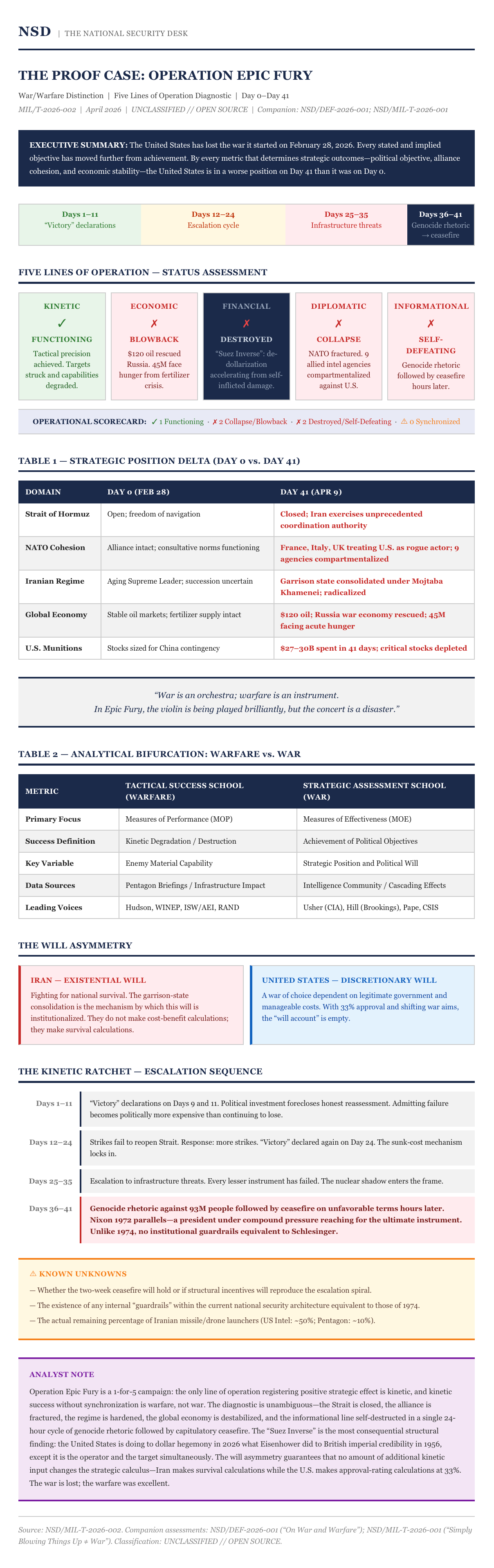
The United States spent $27–30 billion, fired thousands of irreplaceable precision munitions, and killed the Supreme Leader — and every stated objective of Operation Epic Fury is further from achievement on Day 41 than it was on Day 0.
This assessment dismantles the analytical divide defining the debate. One school — Hudson, WINEP, ISW/AEI — scores kinetic destruction and declares victory. The other — a former CIA Senior Intelligence Service officer, Brookings, Chicago, CSIS, the Realist tradition…
Read the full description
— applies the only standard that determines whether wars are won or lost: has the political objective been achieved? Their answer is unanimous.
The campaign handed Iran something more powerful than the nuclear weapon it was launched to prevent. Before February 28, any vessel could transit the Strait of Hormuz freely under international law. Now Iran controls transit, charges tolls exceeding $1 million per ship, and selects who passes. A nuclear weapon is a deterrent you cannot use. The Strait is a weapon Iran uses every day. The cost-exchange ratio on interceptors runs 106-to-1 against the United States. The Pentagon claims 90% degradation of Iranian capability; U.S. intelligence assesses roughly half remains intact.
NSD applies its five-line diagnostic — kinetic, economic, financial, diplomatic, informational — and finds one line functioning, four in collapse. The regime survived and consolidated. Nine allied intelligence agencies have compartmentalised against the U.S. executive branch. The president escalated from liberation rhetoric to genocide threats in six weeks, then accepted a ceasefire on unfavourable terms hours later. The sunk cost fallacy and what NSD calls the kinetic ratchet are now operating in tandem — an escalation spiral with no internal brake.
Why does this matter? If you believe tactical destruction equals strategic success, this assessment identifies the exact analytical failure that produced that conclusion in Vietnam, Afghanistan, and Iraq — materialising now against a live campaign.
Who should listen to this? Defence planners assessing U.S. readiness against China after massive munitions depletion. Intelligence analysts tracking the divergence between Pentagon claims and IC assessments. Arms control professionals evaluating whether the campaign created a more dangerous Iran. Congressional staff weighing the $200 billion supplemental against what it actually bought.
FULL ASSESSMENT HERE
The National Security Desk offers these posts freely, but your support is necessary and appreciated. Please subscribe, paid if you’re able, or leave a tip.
Thank you
This is a public episode. If you would like to discuss this with other subscribers or get access to bonus episodes, visit podcasts.nationalsecuritydesk.com
Short listen plan
No short plan yet. We need saved quotes in chapters with known start and end times, backed by a timed transcript.
The skinny
The skinny isn't ready yet — the transcript is, and you can read it now.
Yesterday, the Secretary of Defense stood at a podium at the Pentagon and declared a decisive military victory for the United States. Right. He looked straight into the cameras and told the world that the enemy's capabilities were just completely shattered. Yeah, that was the phrasing. But today, independent intelligence analysts are warning that this exact same victory, this declared victory, is an illusion. Total illusion, yeah. In fact, they are warning that this operation is about to trigger a… continue reading