Latest / The New Realist Podcast
At 250... Part 6
Today I am beginning with a quote that is near and dear to my heart, so much so that it has a prominent place at the beginning of my book.
It is a quote by Professor Bernard Hennessey who, in 1963 described the US political system as:
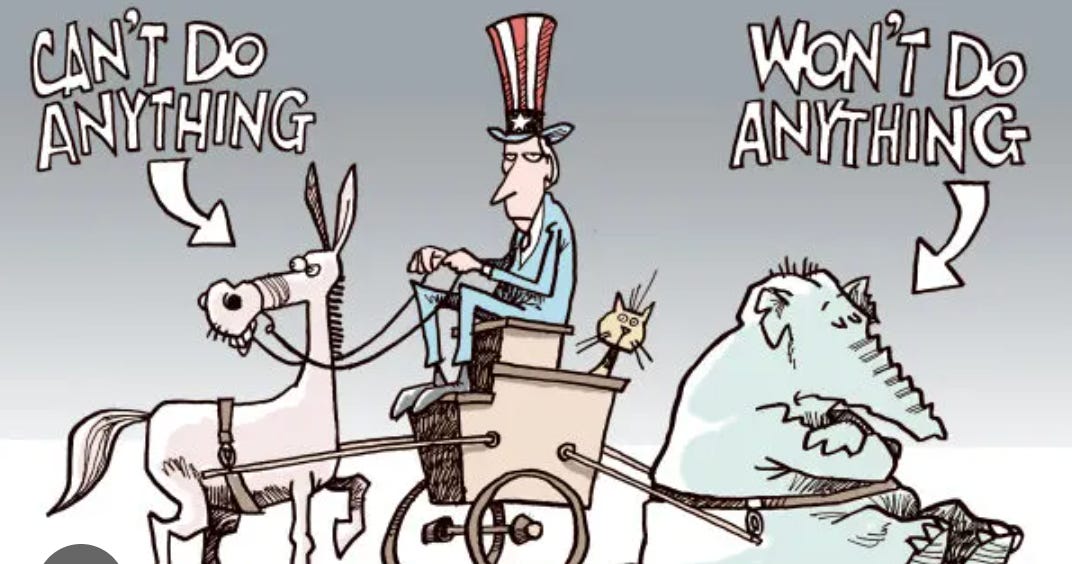
conceived for deadlock and inaction. And, despite some brilliant, if fitful displays of presidential leadership, It remains today as it was conceived, a system for deadlock and inaction.
The quote sums up what I have said and in a previous column/video, I talked about the need to upstream, to go back to the Founding to try to understand why the government is so…
Read the full description
unresponsive, or to use Hennessey’s words, so prone to “deadlock” and “inaction.”
The short answer is it was designed this way.
The reason why the US Framers structured the system this way, however, is a longer story.
After their experience living under the King of England, who they described as a tyrant, the Framers were committed to setting up a free government.
About three decades prior to the American Revolution, Charles Louis de Secondat, Baron de Montesquieu, wrote a monumental text called Spirit of the Laws. It had an enormous impact on thinkers around the world, including the Framers of the US.
Montesquieu recognized the historic import of the book, writing shortly after its publication:
I can say that I have worked on it my whole life… I swear that this book nearly killed me; I am going to rest now; I shall work no more.
True to his word, following the book’s release, Montesquieu never published again.
Montesquieu may have retired from writing, but the impact of his work was far reaching.
In Spirit he argued that the end, or purpose, of a free government was to ensure liberty or freedom.
While we commonly define liberty today as freedom from governmental power, Montesquieu defined it more specifically as freedom from the state or “right to do everything the law permits” unencumbered by the state.
If we reflect on the fact that many of the colonists came to the New World to escape governmental persecution, most prominently to protect their right to worship as well as the fact that they fought a bloody Revolutionary War to throw off a despotic government that was not respecting the rights of the people rights, it is not surprising that Montesquieu’s message resonated with the Framers.
The colonists, revolutionaries, and Framers main and shared goal was to protect liberty and ensure against the abuse of governmental power.
We see this reflected in Declaration of Independence which reads
We hold these truths to be self-evident, that all men are created equal, that they are endowed by their Creator with certain unalienable Rights, that among these are Life, Liberty and the pursuit of Happiness.
Likewise in the Pledge of Allegiance where we pledge to the ‘U.S. Flag and the republic for which it stands... with liberty and justice for all."
The only question then for the Framers was how to design a system which achieved this goal of protecting liberty?
They found their answer in Montesquieu’s Spirit of the Laws where he said the best way to protect liberty is ‘trias politica’ or separation of power.
Which, if you think about it, makes perfect sense. How else to protect liberty but divide governmental power.
And in Montesquieu’s case he advised dividing the power of the state, which had until that point been in the body of one person, the king, into three parts: the legislative, the executive, and the judicial. Each of which possesses different powers and responsibilities.
The US Constitution, as well as many other state constitutions, have adopted Montesquieu’s tripartite system.
What we sometimes describe as the “Madisonian system” is Montesquieu’s separation of powers, coupled with other, additional, divisions of power that Montesquieu did not even imagine.
It is fair to ask why the Framers were intent on dividing power even more than Montesquieu counseled?
The answer is that they feared that mere separation of power, of the kind Montesquieu advised, may not be enough to guard and protect liberty.
So the Framers, worked in an addi
Short listen plan
No short plan yet. We need saved quotes in chapters with known start and end times, backed by a timed transcript.
The skinny
The skinny isn't ready yet — notes appear once the transcript is processed.