Latest / Cramming for the Apocalypse Podcast
The Intertidal System and Foraging with Alanna Kieffer
Hi Friends!
I’m trying something different with this week’s post! A lot of things, in fact.
First, did email-receivers notice the new banner artwork?! My brilliant friend and incredible artist, Amanda Burnham, did such a great job taking what was in my head and putting it in art form and I just love how it turned out and that you all get to see her work each week!
Second, this week’s post is an interview! And not only that, it is an audio interview. With all of the interviews I’ve been conducting for the book, I was inspired and encouraged by some folks to try my hand at a podcast/audio post…
Read the full description
format and I’m so happy that Alanna Kieffer was willing to be my inaugural audio issue/Cramming for the Apocalypse podcast guest. You can either listen to the 35-minute interview or read the full (somewhat edited for clarity) transcript below.
Also, a disclaimer: The audio is okay in most parts, but I’m not an audio expert in the least, so some transitions/cuts are a little rough and my intro/outro audio is a bit tinny, so bear with me. As I learn more, refine my skills, and find the time to dive into learning about this stuff, I hope it’ll get better/more professional as we go on, but I know I’m among friends here and you’ll appreciate it nonetheless ;).
In April 2022, I officially launched my research for this book project by taking a clamming class on the Oregon Coast with my friend, Lindsey. In advance of the class, I began to get nervous. It was a really rainy, cold spring in the PNW and I just pictured myself out there in the mud flats, soaking wet and miserable.
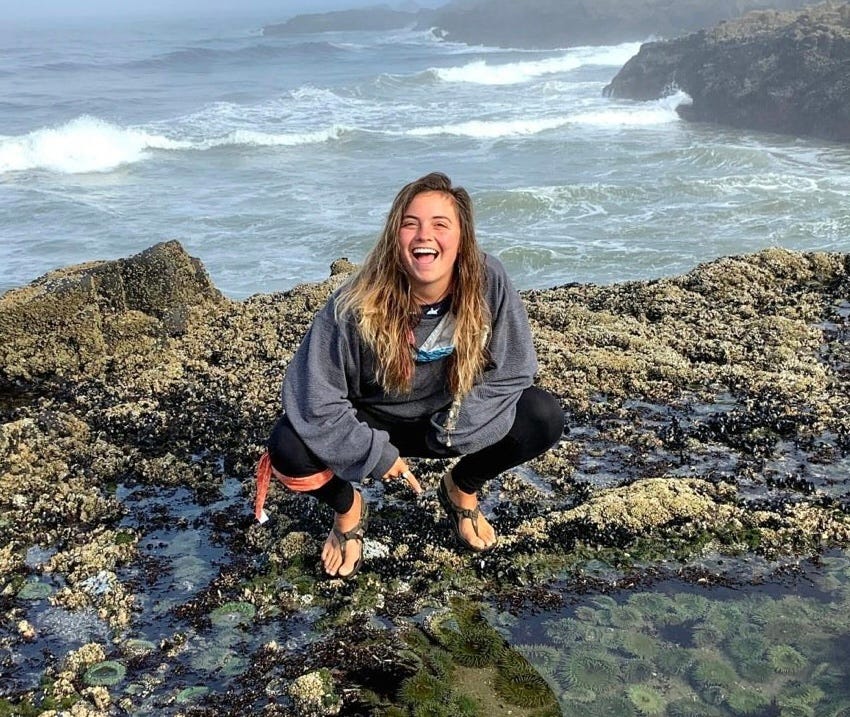
It turned out to be anything but miserable. It was truly an incredible experience, and not just because it was resplendent and sunny. The fun and joy I felt were partially due to the instructor, Alanna Kieffer, who so very clearly had an outsized affection for the ocean and the creatures therein. Her enthusiasm was contagious. And as I approached the year anniversary of launching my immersive research, I thought I’d interview Alanna. And bonus, she agreed to be featured in my inaugural audio issue/podcast episode of Cramming for the Apocalypse.
Elizabeth Doerr: Thank you so much for chatting with! Let’s start by telling me about yourself and your various roles.
Alanna Kieffer: My name is Alanna Kieffer and I wear a lot of hats. But I'm a marine science educator as a whole. I've been working for Oregon seaweed for the past two years. So I'm farming dulse seaweed on the Oregon coast, but also pushing that into communities. So doing a lot of community outreach around seaweed and yeah, just educating people in that world, but on the side do a lot of intertidal for gene and just exploration on my own and have been pretty excited to get involved in that and like more of an educational pulling other people in as well. But yeah, longtime and marine science education.
ED: Tell me a little bit about how you got to where you are today.
AK: It's been a journey. I moved to Oregon about 10 years ago, me and my mom moved from the East Coast to Seaside where I finished high school. I knew forever that I wanted to get involved with marine biology so when we came out here, I immediately started working in intertidal systems. I really knew nothing about the ocean in general. And as a high schooler I was working at an environmental education program down at the base of Haystack Rock in Cannon Beach, which is really focused on protection through education. So in order to teach people about it, I had to learn everything I could, and I really cherish that I was getting this immediate hands-on experience. I wasn't doing anything in the world of academia. But I was in high school spending every day in the intertidal with ID books and with other people who had spent years in this ecosystem and really just learning from there. And I think that sparked my interested. I realized that no matter what I did in marine biology, I needed to be educating people and working on the communication side of things.
So I went to OSU [Oregon State University] and studied marine biology. I went to Australia studi
Short listen plan
No short plan yet. We need saved quotes in chapters with known start and end times, backed by a timed transcript.
The skinny
The skinny isn't ready yet — the transcript is, and you can read it now.
Hello! Welcome to the first installment of my audio issue of the Cramming for the Apocalypse newsletter. I had been conducting a lot of interviews for this book project and for this newsletter and so I thought I'd give it a shot to do a kind of podcast. it's a bit of a learning curve given that I don't know anything about doing audio or recording audio so this current recording is not the greatest as far as quality goes… continue reading