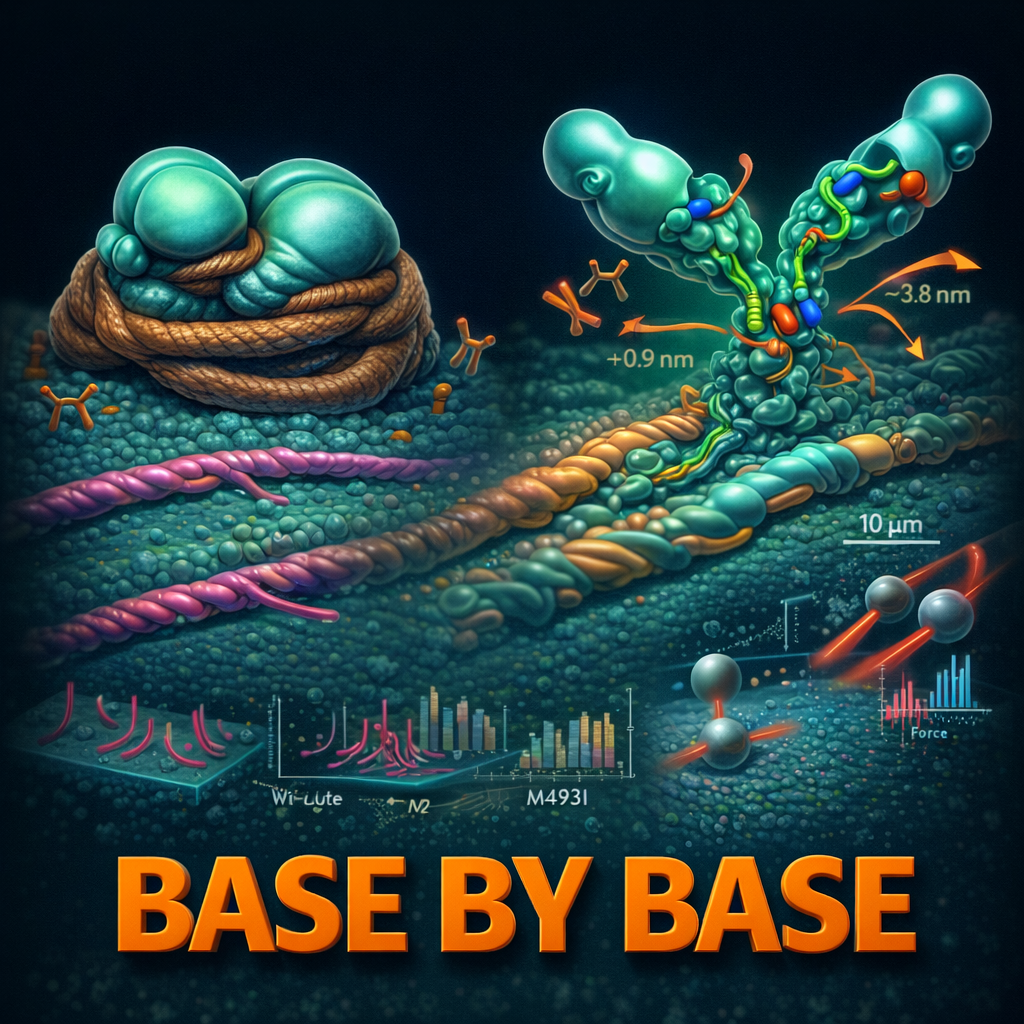
268: M493I in human β-cardiac myosin: SRX disruption, slow ADP release, and enhanced actin attachment
Cail RC et al., Proc. Natl. Acad. Sci. U.S.A. 2025.122:e2521561122 - Recombinant human β-cardiac myosin M493I studied by optical trapping and stopped-flow kinetics disrupts the super-relaxed state and increases actin attachment and contractile force. Key terms: β-cardiac myosin, M493I, super-relaxed state, actin attachment, optical trap.
Study Highlights:
System: recombinant human β-cardiac heavy meromyosin (cHMM) expressed in C2C12 cells. Methods: ensemble actin gliding, stopped-flow kinetics, NADH ATPase, mantATP single-turnover, and single-molecule three-bead optical trap assays. Main…
Read the full description
results: M493I preserves Pi release and the two-step 4.7–5 nm working stroke but slows ADP release ~5-fold, doubles steady-state ATPase Vmax, reduces SRX occupancy (KSRX/DRX from ~0.33 to ~0.53), and prolongs actin attachment with increased high-force, long-duration interactions. Functional implication: the combined increase in DRX head availability and prolonged AM·ADP lifetimes produce higher sustained force and faster actin reattachment consistent with a mechanism for HCM hypercontractility and impaired relaxation.
Conclusion:
The M493I relay-helix mutation disrupts the SRX off state and, together with slowed ADP release and prolonged actin attachment, increases myosin head availability and force production, explaining its hypercontractile HCM phenotype.
QC:
This episode was checked against the original article PDF and publication metadata for the episode release published on 2026-01-23.
QC Scope:
- article metadata and core scientific claims from the narration
- excludes analogies, intro/outro, and music
- transcript coverage: Audited transcript sections covering the M493I mutation in the relay helix, SRX/DRX equilibrium and head availability, ADP release kinetics and duty ratio, actin gliding and power stroke, isometric high-force attachments, single-molecule actin reattachment dynamics, and mavacamten/therapeutic implications.
- transcript topics: M493I mutation in relay helix and mechanistic role; SRX/DRX equilibrium and head availability; ADP release kinetics and duty ratio; Actin gliding velocity and power stroke; Isometric high-force attachments under hindering load; Single-molecule actin reattachment dynamics
QC Summary:
- factual score: 10/10
- metadata score: 10/10
- supported core claims: 6
- claims flagged for review: 0
- metadata checks passed: 4
- metadata issues found: 0
Metadata Audited:
- article_doi
- article_title
- article_journal
- license
Factual Items Audited:
- M493I slows ADP release ~5-fold (ADP release ~12 s−1 vs ~69 s−1 for WT).
- Actin gliding velocity reduced ~70% (WT ~1.6 μm/s; M493I ~0.46 μm/s).
- SRX/DRX disruption: SRX/DRX equilibrium constant ~0.53 (M493I) vs ~0.33 (WT); DRX heads ~35% vs ~25%.
- Duty ratio increases from ~0.017 (WT) to ~0.20 (M493I).
- Power output under hindering load (0–10 pN) nearly twofold higher for M493I vs WT.
- Single-molecule actin reattachment fastest component ~1.62 s−1 (M493I) vs ~0.83 s−1 (WT).
QC result: Pass.
Chapters
(00:00:00) - Heart Hypertrophic Cardiomyopathy: The genetic puzzle
(00:04:48) - Myosin motors: Do they Pull or Float?
(00:07:50) - Heart Disease: M493I mutant causes heart to slow
(00:12:16) - Heart dysrhythmias: The sticky insomniac motor
(00:17:54) - Hold on Hold On
Short listen plan
No short plan yet. We need saved quotes in chapters with known start and end times, backed by a timed transcript.
The skinny
The skinny isn't ready yet — the transcript is, and you can read it now.
Foreign. Welcome to Base by Bass, the papercast that brings genomics to you wherever you are. Thanks for listening and don't forget to follow and rate us in your podcast app. It's great to be here. So I want to start today with a kind of a mechanical paradox. I want you to imagine a high performance engine, you know, something from a race car. Okay, got it. You're watching it on the track and it is just screaming. It's… continue reading