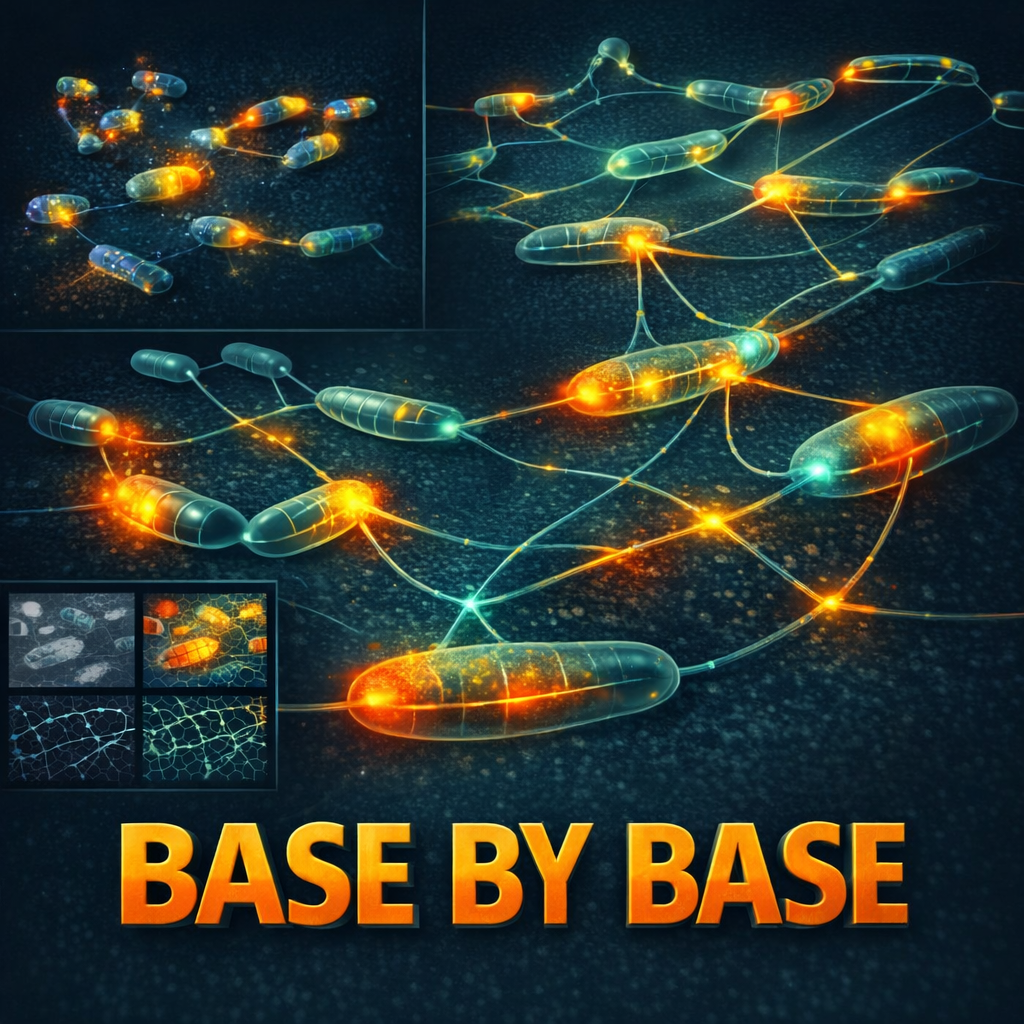
347: Diffusive spreading across dynamic mitochondrial network architectures
Holta KB et al., Proceedings of the National Academy of Sciences (PNAS) - This episode explains a quantitative framework for diffusion on spatially embedded dynamic mitochondrial networks. The study combines analytic theory, agent-based simulations, and live-cell imaging to show how connectivity, fusion/fission, and mobility set biomolecular mixing on mitochondrial populations. Key terms: mitochondria, diffusion, intracellular transport, temporal networks, fusion-fission.
Study Highlights:
The authors develop an analytic and simulation framework for diffusive spreading on spatially embedded…
Read the full description
dynamic networks formed by mitochondrial fusion and fission. They identify a connectivity-driven transition from three-dimensional dispersion across transiently interacting clusters (social regime) to low-dimensional transport along largely stationary interconnected tubules (physical regime). The steady-state distribution is determined by competing timescales for cluster filling, encounter, fusion/fission, and material decay. Application to three human cell lines reveals cell-type variability in predicted spreading times, with hyperfused networks limited by intracluster diffusion and fragmented networks limited by encounters.
Conclusion:
Network connectivity and the balance of diffusion, encounter, and fusion/fission timescales quantitatively determine mitochondrial material homogenization, producing distinct scaling regimes with measurable predictions across cell types.
Music:
Enjoy the music based on this article at the end of the episode.
Article title:
Diffusive spreading across dynamic mitochondrial network architectures
First author:
Holta KB
Journal:
Proceedings of the National Academy of Sciences (PNAS)
DOI:
10.1073/pnas.2523913123
Reference:
Holta KB, Zurita C, Teryoshin L, Lewis SC, Koslover EF. Diffusive spreading across dynamic mitochondrial network architectures. Proc Natl Acad Sci U S A. 2026;123(15):e2523913123. doi:10.1073/pnas.2523913123
License:
This episode is based on an open-access article published under the Creative Commons Attribution 4.0 International License (CC BY 4.0) – https://creativecommons.org/licenses/by/4.0/
Support:
Base by Base – Stripe donations: https://donate.stripe.com/7sY4gz71B2sN3RWac5gEg00
Official website https://basebybase.com
On PaperCast Base by Base you'll discover the latest in genomics, functional genomics, structural genomics, and proteomics.
Episode link: https://basebybase.com/episodes/diffusive-spreading-mitochondrial-networks
QC:
This episode was checked against the original article PDF and publication metadata for the episode release published on 2026-04-19.
QC Scope:
- article metadata and core scientific claims from the narration
- excludes analogies, intro/outro, and music
- transcript coverage: Substantive auditing of the transcript’s representation of the article’s core framework, regimes, timescales, cell-type predictions, modeling approach, and acknowledged limitations, with cross-checks against the original article text and the facts pack.
- transcript topics: Temporal networks framework for diffusion on dynamic mitochondrial networks; Physical vs social mitochondrial network regimes; Four timescales governing diffusion: decay, cluster filling, encounter, fission; Agent-based spherocylindrical model and finite-volume diffusion; Time-resolved imaging and cell-type parameterization (SH-SY5Y, IMR90, U2OS); Predictions of spreading times across cell types
QC Summary:
- factual score: 10/10
- metadata score: 10/10
- supported core claims: 7
- claims flagged for review: 0
- metadata checks passed: 4
- metadata issues found: 0
Metadata Audited:
- article_doi
- article_title
- article_journal
- license
Factual Items Audited:
- Connectivity-driven transition between low-dimensional (physical) and three-dimensional (social) network regimes
- Four timescales govern spreading: decay, cluster filling, encounter, and fission
- Spreading times: SH-SY5Y ~6 minutes; IMR90/U2OS ~45 minutes for Dp = 20 μm2/s
- Mobility of mitochondria can bottleneck spreading in fragmented networks
- Active
Short listen plan
No short plan yet. We need saved quotes in chapters with known start and end times, backed by a timed transcript.
The skinny
The skinny isn't ready yet — notes appear once the transcript is processed.