Latest / Closed Circuit Selling™ w/ Adem Manderovic + George Coudounaris
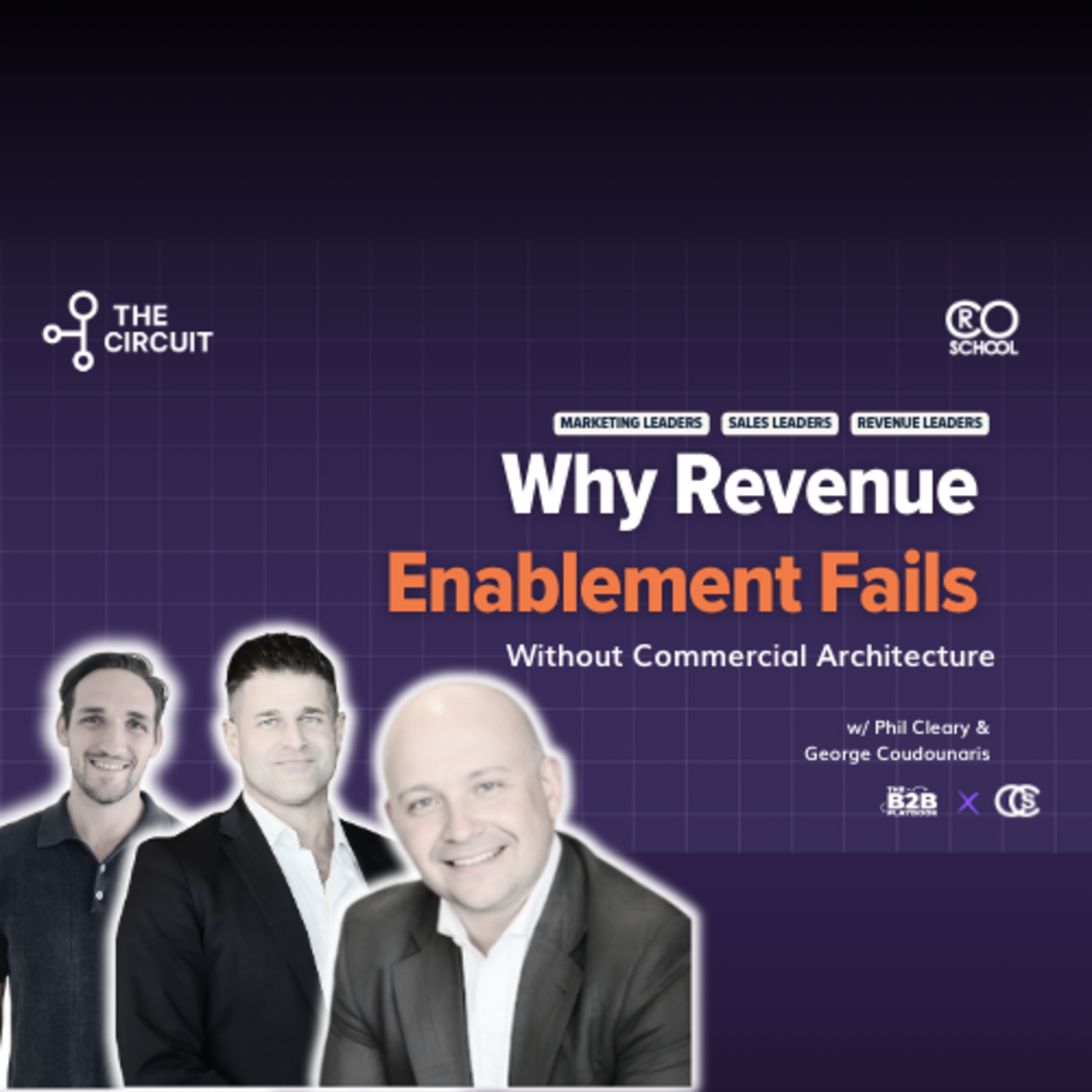
Ep 124 - Why Revenue Enablement Fails Without Commercial Architecture w/Phil Cleary & George Coudounaris
Your Pipeline Isn’t Unpredictable. It’s Unvalidated.
Revenue leaders across SaaS and enterprise sales are describing the same tension:
Pipeline coverage looks fine.
CRM stages are full.
Forecast calls still run.
Yet confidence feels thinner than it used to.
Close dates slip.
Deal sizes shrink late.
Forecast conversations rely more on narrative than proof.
In a recent discussion, Phil Cleary, who spent over two decades leading revenue enablement at Salesforce, described the issue clearly:
“The realness of the pipeline… how much of it is fabricated.”
Fabricated doesn’t mean dishonest.
It means…
Read the full description
structurally unvalidated.
Deals can progress through stages without being stress-tested for viability. Confidence rises faster than evidence. Stage movement becomes a substitute for truth.
That gap is where predictability erodes.
When validation isn’t enforced by the system, pipeline can look stable while remaining fragile.
Coverage ratios stay healthy.
Forecasts still get submitted.
Leaders still feel exposed.
As Phil Cleary surfaced, the uncertainty many leaders feel isn’t coming from effort or intent — it’s coming from a validation gap. The system allows opportunities to advance without consistently proving they deserve to.
At scale, this creates what many leaders call fake pipeline.
Not invented deals — unproven ones.
A viable deal has evidence behind it.
Not enthusiasm.
Not activity.
Not good discovery calls.
Viability requires clear answers to simple questions:
Who is driving this internally — and do they have influence?
What triggered urgency?
What alternatives are being considered?
What could stop this?
What defines success post–go-live?
What is the real decision path?
Why now?
When is the renewal or contract event?
When those answers are missing, the opportunity may be real.
It just isn’t forecastable.
This is where Adem Manderovic and George Coudounaris introduced cataloguing within Closed Circuit Selling™.
Cataloguing isn’t CRM hygiene.
It’s capturing buyer truth in plain language so the organisation stops guessing.
It doesn’t speed buyers up.
It stops probability inflation.
Phil Cleary also highlighted a critical shift in buyer psychology:
Fear of Messing Up now outweighs Fear of Missing Out.
When buyers fear personal or reputational risk, decision cycles lengthen, committees expand, and scrutiny intensifies.
From the outside, this looks like unpredictability.
Inside the system, it exposes weak validation and poor continuity.
Better questioning frameworks don’t solve that.
Visible commercial continuity does.
Revenue volatility isn’t a skills problem.
It’s a system design problem.
Closed Circuit Selling™ is not a sales methodology.
It is a commercial architecture.
When validation, handover, delivery, and retention aren’t governed by a unified system, volatility is inevitable.
When they are, confidence compounds.
Your pipeline isn’t unpredictable.
It’s unvalidated.
Pipeline Volatility Is a Validation ProblemWhat Viability Actually MeansFOMO vs FOMUThe Bottom Line
The bookhttps://www.amazon.com.au/Closed-Circuit-Selling-Predictable-Unpredictable/dp/B0GQ2YV52Y/
Partner pagehttps://theb2bplaybook.com/ccs-resources
More about our programshttps://theb2bplaybook.com/cro-school
Short listen plan
No short plan yet. We need saved quotes in chapters with known start and end times, backed by a timed transcript.
The skinny
The skinny isn't ready yet — notes appear once the transcript is processed.