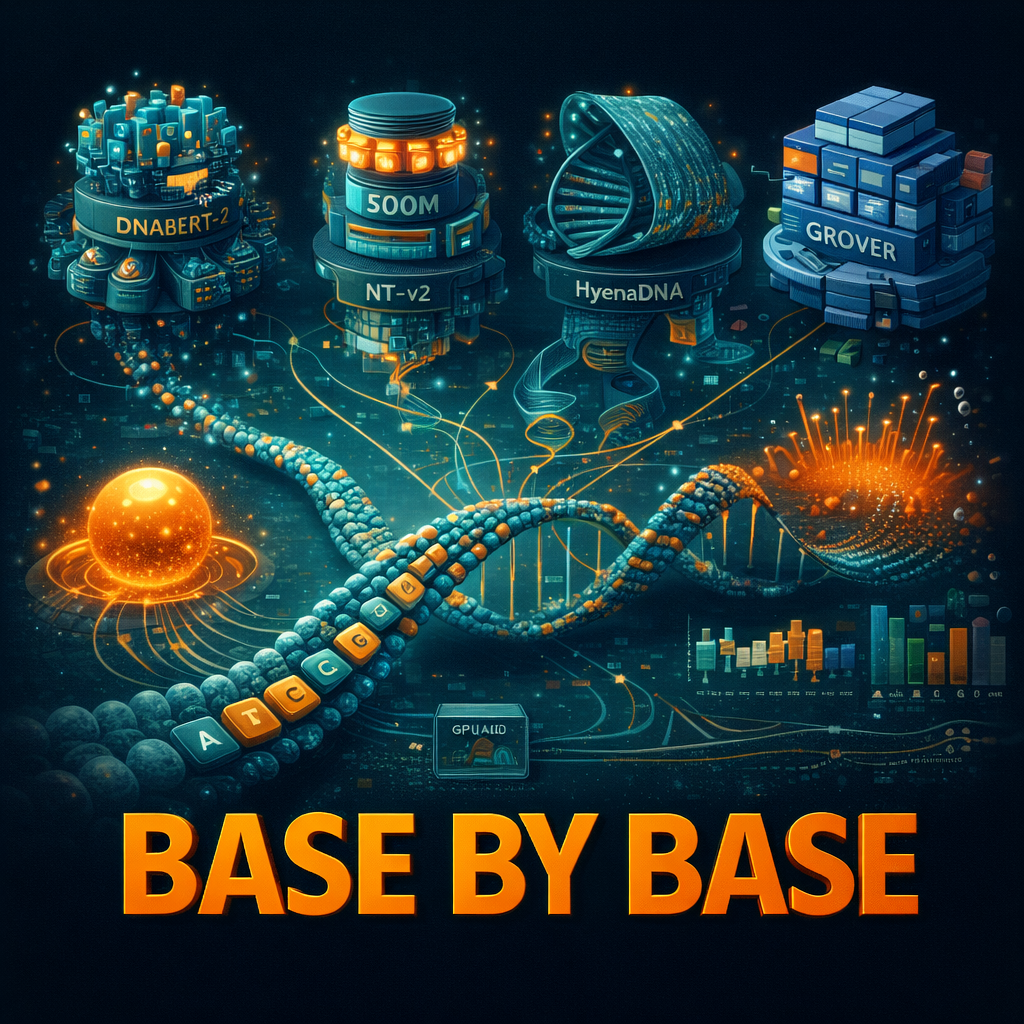
245: Benchmarking DNA foundation models
Feng H et al., Nat Commun - A comprehensive, unbiased benchmark compares five DNA foundation models across 57 datasets and multiple tasks, finding mean token embeddings improve classification and that model strengths vary by task and pre-training. Key terms: DNA foundation models, mean token embedding, sequence classification, variant effect, gene expression.
Study Highlights:
The study evaluated DNABERT-2, NT-v2, HyenaDNA, Caduceus-Ph, and GROVER on 57 datasets spanning sequence classification, gene expression prediction, variant effect quantification, and TAD recognition. Mean token…
Read the full description
embedding consistently and significantly outperformed summary-token and max pooling for sequence classification. Model performance was task-dependent: Caduceus-Ph excelled at human TFBS and promoter tasks, NT-v2 led pathogenic variant identification, HyenaDNA scaled efficiently and benefited from multi-species pre-training, while specialized models outperformed general foundations on QTL prediction. Zero-shot embeddings provided modest gene expression prediction and NT-v2 attention patterns did not reveal inherent TAD recognition.
Conclusion:
Mean token pooling yields more robust sequence-level representations and model choice should align with task, input length, and pre-training data for best genomic performance
Music:
Enjoy the music based on this article at the end of the episode.
First author:
Feng H
Journal:
Nat Commun
DOI:
10.1038/s41467-025-65823-8
Reference:
Feng H, Wu L, Zhao B, Huff C, Zhang J, Wu J, Lin L, Wei P & Wu C. Benchmarking DNA foundation models for genomic and genetic tasks. Nat Commun. 2025;16:10780. https://doi.org/10.1038/s41467-025-65823-8
License:
This episode is based on an open-access article published under the Creative Commons Attribution 4.0 International License (CC BY 4.0) – https://creativecommons.org/licenses/by/4.0/
Support:
Base by Base – Stripe donations: https://donate.stripe.com/7sY4gz71B2sN3RWac5gEg00
Official website https://basebybase.com
On PaperCast Base by Base you’ll discover the latest in genomics, functional genomics, structural genomics, and proteomics.
Episode link: https://basebybase.com/episodes/dna-foundation-models-benchmark
QC:
This episode was checked against the original article PDF and publication metadata for the episode release published on 2025-12-31.
QC Scope:
- article metadata and core scientific claims from the narration
- excludes analogies, intro/outro, and music
- transcript coverage: Audited the transcript's coverage of core scientific claims: DNA foundation models benchmarking, pooling strategies (mean token embedding), zero-shot embeddings with a downstream classifier, VEQ dichotomy, multispecies pre-training and cross-species generalization, long-sequence performance, TAD recognition limitations
- transcript topics: DNA foundation models and zero-shot embeddings; Pooling strategies for sequence representations (mean token embedding vs summary/max pooling); Downstream classification using zero-shot embeddings (random forest); Variant effect quantification: pathogenic vs QTL (VEQ dichotomy); Multispecies pre-training and cross-species generalization; Cross-species transfer in promoter identification (Arabidopsis example)
QC Summary:
- factual score: 10/10
- metadata score: 10/10
- supported core claims: 8
- claims flagged for review: 0
- metadata checks passed: 4
- metadata issues found: 0
Metadata Audited:
- article_doi
- article_title
- article_journal
- license
Factual Items Audited:
- Mean token embedding consistently improves sequence classification across all foundation models and yields measurable AUROC gains.
- Zero-shot embeddings with frozen weights are evaluated with a downstream random forest classifier to measure embedding quality without fine-tuning.
- VEQ dichotomy: generalists excel at pathogenic variant identification; specialized models excel at tissue-specific QTL predictions.
- Multispecies pre-training improves generalization; 14 of 49 tasks show statistically significant improvements, with some tasks favoring human-only pre-training.
- Cross-specie
Short listen plan
No short plan yet. We need saved quotes in chapters with known start and end times, backed by a timed transcript.
The skinny
The skinny isn't ready yet — notes appear once the transcript is processed.