Latest / The New Realist Podcast
At 250... Part 9
This is the ninth video in a series I am recording in honor of the 250th Anniversary of the Declaration of Independence and the release of my most recent book, American Democracy in Crisis. If you have not had a chance to listen to the previous videos, I invite you to do that.
As usual I am going to begin with a quote, then say a few words about it.We are told that America is divided and polarized as never before. Yet when it comes to many important areas of policy, that simply isn’t true.
Columbia law professor Tim Wu said this in an editorial published in 2019.
A few weeks ago, another…
Read the full description
editorial entitled “Americans are not so polarized” was published. This one by pollster Kristen Soltis Anderson, who makes a similar claim.
What is going on? After all, the popular narrative in the media is that we are living in polarized times. Today, Americans are more polarized than ever.
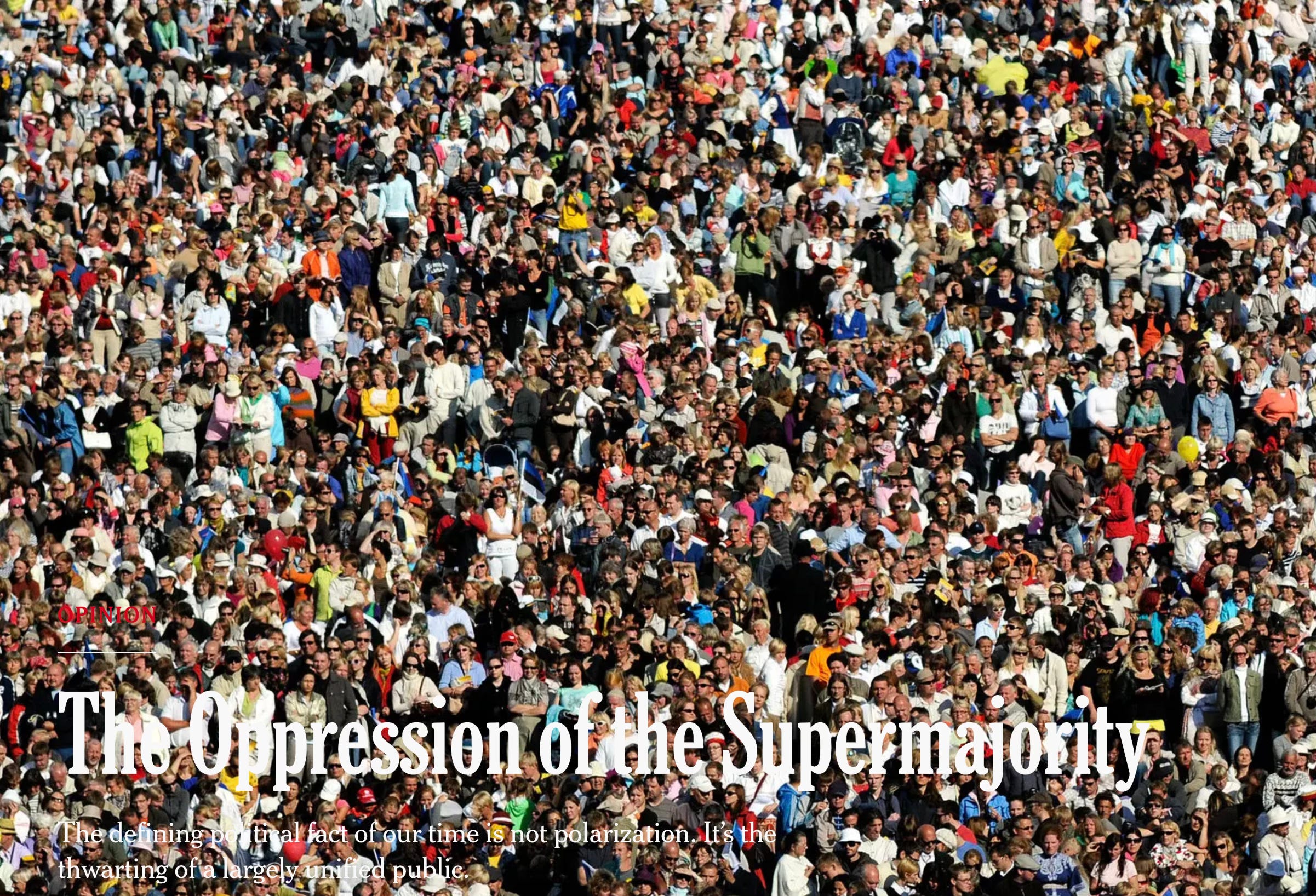
And in fact, if you ask someone what’s wrong with American democracy, they often tell you, it’s due to polarization. But in fact, as Wu and Anderson show, the American public is not nearly as polarized as we are often led to believe.
Wu points to several policies supported by super-majorities: more than nine out of every ten Americans back Medicare negotiating for lower drug prices; more than eight out of ten favor net neutrality; seven out of ten approve of higher taxes for the ultra-wealthy; and three-quarters believe we should be able to buy drugs imported from Canada.
Likewise, as Anderson shows, “few Americans live at the extremes. In my data, only 13 percent of Americans hold views that could be categorized as “strong liberal” and only 11 percent as “strong conservative.” But it is the remaining three-quarters of Americans who are fascinating to categorize — they defy what many people may think of as America’s political center.”
Given these numbers, the major problem we are facing may not be polarization.
This is why as opposed to asking why people don’t agree and why we are so polarized, maybe we should be asking: why is the government incapable of acting on the wishes of most Americans? Why in the oldest democracy in the world is the majority so often ignored?
The answer is the system itself; the US has a governmental system that has largely succeeded in doing what it was originally designed to do, i.e., to frustrate majority rule and responsiveness.
In the last several videos I have discussed why the Framers designed the system this way (the answer is to preserve liberty).
I have also discussed what the earliest Americans did to try to make the system work, they turned to political parties. Of course, parties have proven to be a semi-solution to the problem.
In this video, and the next, I address what are the consequences of this structure as it pertains to specific policy areas.
The first consequence is a lack of responsiveness to the majority. We can illustrate this using several issues, but I am going to focus on one that America has faced for decades – illegal immigration.
Even though people across the political spectrum agree the U.S. immigration system is in crisis, the federal government for decades failed to rectify the problem. Like most Americans, President Obama came to office in 2009 convinced that something had to be done, at the very least to protect the most vulnerable population, the undocumented young people who were brought to the United States as children. His concerns about the Dreamers were shared by most Americans.
Polls at the time showed that three quarters of respondent’s support legalization for people who were brought to the United States as children.
Several years into his administration, however, an exasperated Obama finally declared he could no longer hold out hope for congress to resolve the issue and he launched an initiative called “We Can’t Wait.” In the absence of congressional authorization, he proceeded unilaterally. Despite concerns about the constitutionality, he issued an Executive Order ‘Deferred Action for Childhood Arrivals [or DACA] to protect the dreamers.
Obama was not alone in his efforts to add
Short listen plan
No short plan yet. We need saved quotes in chapters with known start and end times, backed by a timed transcript.
The skinny
The skinny isn't ready yet — notes appear once the transcript is processed.